

If you’re counting on an emotional support animal to help you feel steady, safe, and at home, the last thing you need is to get tripped up by paperwork. ESA letter laws determine who can write your documentation, what it must include, and how long the process can legally take. These rules are not the same everywhere. Every state follows the same federal housing protections, but some states add their own requirements for the licensed professionals who issue ESA letters.
That distinction matters most when it comes to timing. One of the most common questions people ask is whether they can get an ESA letter on the same day they see a provider. In most states, the answer is yes once a legitimate evaluation is completed. However, five states require a 30-day client-provider relationship before a provider can issue an ESA letter. This requirement does not apply nationwide. This guide explains exactly which states have the 30-day rule and what to expect from ESA letter laws across all 50 states, so you can understand the requirements before starting the process.
Understanding ESA Letter Laws by States
ESA letter laws are the combination of federal and state rules that govern how a person qualifies for and documents an emotional support animal. They cover who can write the letter, what the letter must contain, and how the documentation is treated when you request a housing accommodation. Understanding these rules can help you avoid wasted time, invalid paperwork, and providers who do not follow legal requirements.
An ESA letter establishes that a person has a disability-related need for the emotional or therapeutic benefit an animal provides. A licensed healthcare professional, such as a therapist, counselor, psychologist, or physician, typically writes the letter after assessing the person’s condition and determining that the animal provides meaningful support.
This is different from simply owning an emotional support animal. The letter provides documentation of the disability-related need when you request a reasonable accommodation from a housing provider.
Federal Laws for ESA Letter
Federal law does not require a specific ESA letter template. However, documentation may be requested when you seek a reasonable accommodation for housing and your disability or disability-related need is not readily apparent.
The Fair Housing Act provides the federal framework for reasonable accommodations involving assistance animals. State laws can add requirements for healthcare professionals who provide supporting documentation, but they do not replace federal housing protections.
Federal ESA Registration Requirements
There is no federal ESA registry, and no government agency issues an official ESA certification. Registering an animal in a database or purchasing a certificate does not establish legal ESA status.
A legitimate ESA letter comes from a qualified healthcare professional who has evaluated the person’s need for the animal. Online services that sell registration numbers, certificates, vests, or ID cards are selling products or services, not creating a government-recognized ESA status. Claims that an ESA registration can instantly provide legally binding status should therefore be treated with caution.
Federal ESA Laws vs. State ESA Letter Laws
Before looking at individual states, it helps to understand how federal and state laws work together. Federal law provides the baseline protection nationwide, while state laws may add requirements for professionals who provide ESA documentation.
Fair Housing Act Protections for Emotional Support Animals
Under the Fair Housing Act (FHA), a person with a disability may request a reasonable accommodation to a no-pet policy when an emotional support animal is needed because of that disability, including how to submit an ESA request to your landlord. Housing providers generally cannot treat a qualifying ESA as an ordinary pet or charge pet-related fees such as pet rent or a pet deposit when the accommodation is required. They can, however, request reliable information when the disability or disability-related need for the animal is not obvious.
ESA Laws Under the ADA
The Americans with Disabilities Act (ADA) makes an important distinction between service animals and emotional support animals. Service animals are individually trained to perform specific tasks for people with disabilities and generally have public-access rights under the ADA. Emotional support animals do not have the same public-access rights because their role is providing emotional support rather than performing specific disability-related tasks.
An ESA letter does not turn an emotional support animal into a service animal. Using an ESA letter to claim public-access rights that apply to service animals can lead to problems.
State-Specific ESA Letter Laws
State laws may regulate the professionals who provide ESA documentation rather than changing the federal housing protections themselves. Depending on the state, requirements may address professional licensing, clinical evaluations, telehealth practices, or the length of the provider-client relationship before documentation can be issued.
Some states have specific rules that can affect how quickly a licensed professional may provide an ESA letter. This is why checking your state’s requirements is important before relying on documentation for a housing accommodation.
Federal housing protections apply nationwide, but state requirements can affect how ESA documentation is obtained and whether a professional is permitted to issue it. Reviewing both federal and state rules can help you understand the applicable requirements, avoid invalid documentation, and prevent unnecessary delays when requesting an ESA housing accommodation.
ESA Letter Laws: States With a 30-Day Relationship Requirement
In a small number of states, a licensed provider cannot write ESA letters for rental housing for a new client until they have maintained a genuine client-provider relationship with that person for at least 30 days. This relationship must involve real clinical contact, including an initial evaluation and typically follow-up care, rather than a single intake form.
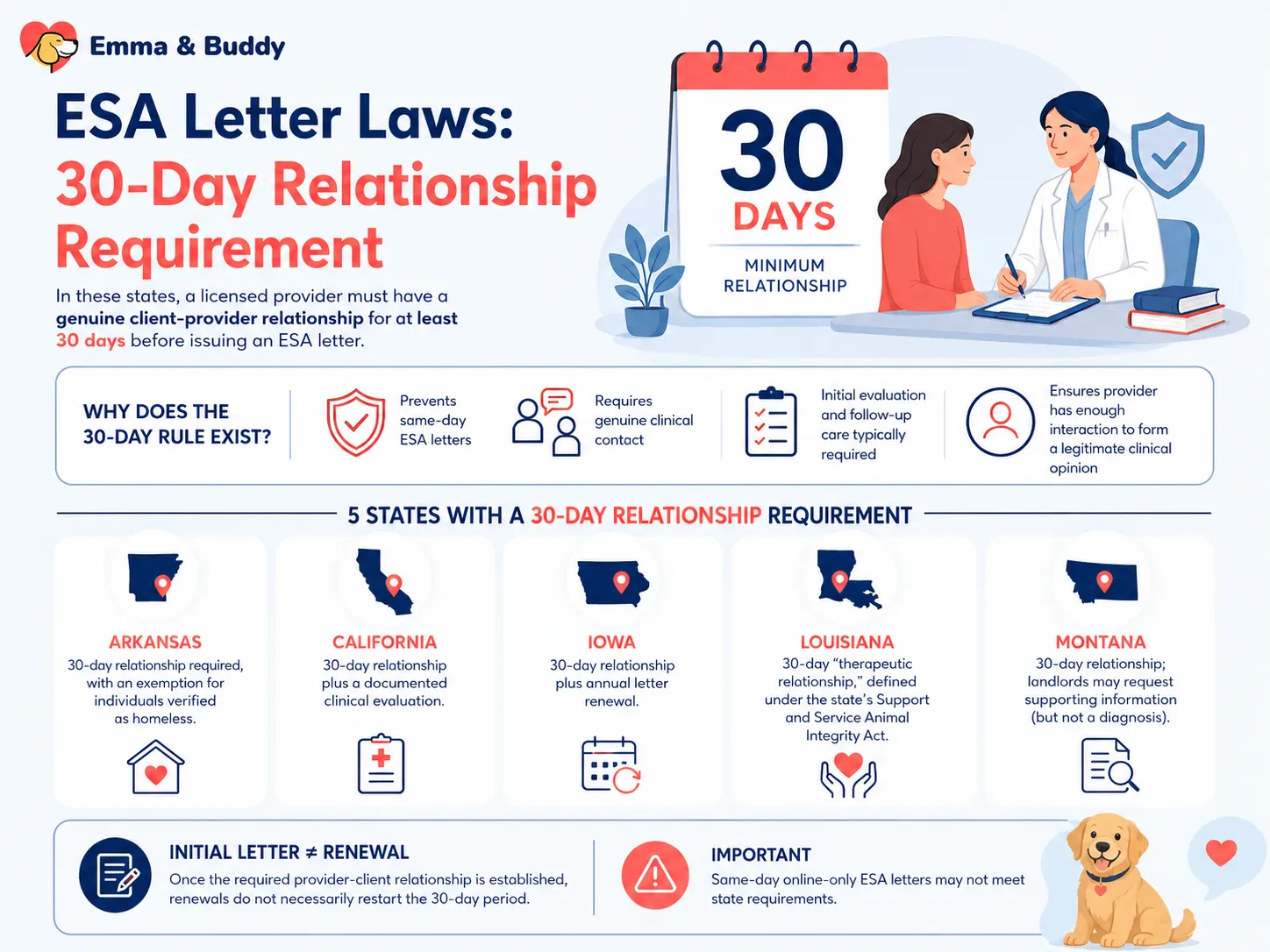
The rule exists to prevent same-day, online-only ESA letters in these states. Lawmakers wanted providers to have enough interaction with a patient to develop a legitimate clinical opinion before recommending an emotional support animal.
It is also important to distinguish the initial ESA letter from later renewals. Once the required 30-day provider-patient relationship has been established, ongoing documentation does not necessarily require starting the 30-day period again.
| State | 30-Day Relationship | Special Requirement |
|---|---|---|
| Arkansas | Yes | Established client-provider relationship required, with an exemption for individuals verified as homeless |
| California | Yes | 30-day relationship plus a documented clinical evaluation |
| Iowa | Yes | 30-day relationship plus annual letter renewal |
| Louisiana | Yes | 30-day “therapeutic relationship,” defined under the state’s Support and Service Animal Integrity Act |
| Montana | Yes | 30-day relationship; landlords may request supporting information (but not a diagnosis) |
These five states Arkansas, California, Iowa, Louisiana, and Montana, have each passed dedicated legislation requiring a minimum 30-day client-provider relationship before a licensed professional can issue an ESA letter.
What Happens During the 30-Day Period?
The 30-day period typically includes an initial consultation where the provider reviews the person’s history and current symptoms, a clinical evaluation of how an ESA may support treatment, and enough follow-up contact to establish a genuine provider relationship rather than a one-time transaction. Once the relationship and evaluation are complete, along with any state-specific requirements, the provider can issue the documentation.
It depends entirely on your state that you get an esa letter in less than 30 days or not. In the 45 states without this requirement, a legitimate provider may issue an ESA letter after completing a genuine evaluation, sometimes within days. In Arkansas, California, Iowa, Louisiana, and Montana, the relationship requirement is a legal minimum, not simply a guideline. A provider who bypasses it may issue documentation that does not comply with state law, potentially putting both the letter and their professional license at risk.
ESA Letter Laws: State-by-State Rules
Every state, whether or not it has a specific ESA statute, is covered by the federal Fair Housing Act. States without a dedicated ESA letter law are not “unregulated.” Instead, they generally follow the federal framework along with applicable professional licensing rules for healthcare providers. These states may not impose a separate waiting period or 30-day requirement for ESA documentation.
Alabama ESA Letter Laws
Alabama does not impose a specific 30-day relationship requirement before a healthcare professional can issue documentation supporting an emotional support animal (ESA). An ESA letter should be based on a genuine evaluation by an appropriately licensed healthcare or mental health professional who determines that the individual has a disability and that the animal provides disability-related emotional support or assistance. Alabama does not have a separate state statute establishing a 30-day ESA-letter waiting period, so housing requests involving assistance animals generally fall under the federal Fair Housing Act, which requires housing providers to consider reasonable accommodation requests supported by reliable disability-related information when appropriate.
Alaska ESA Letter Laws
Alaska does not currently impose a state-mandated 30-day client-provider relationship before a qualified professional can provide documentation supporting an emotional support animal. Instead, ESA-related housing requests are primarily governed by the federal Fair Housing Act, under which an assistance animal may qualify as a reasonable accommodation when it is necessary because of a disability. When the disability or disability-related need is not readily apparent, a housing provider may request reliable disability-related information from a qualified healthcare or mental-health professional. Alaska does not appear to have a separate statute establishing a 30-day ESA-letter waiting period, although licensed professionals remain subject to Alaska’s applicable licensing laws, regulations, and professional standards.
Arizona ESA Letter Laws
Arizona does not require a 30-day therapeutic or client-provider relationship before a licensed healthcare or mental health professional can issue documentation supporting an emotional support animal (ESA). For housing, Arizona law recognizes “assistance animals,” including animals that provide therapeutic or emotional support for a person with a disability, while the federal Fair Housing Act requires housing providers to consider reasonable accommodation requests supported by reliable disability-related information when the disability or disability-related need is not apparent. An ESA letter should therefore be based on an individualized evaluation by an appropriately licensed healthcare professional who can reliably document the person’s disability-related need for the animal.
Arkansas ESA Letter Laws
Arkansas law requires a healthcare provider to establish a client-provider relationship at least 30 days before providing documentation of the individual’s need for an emotional support dog, with an exception for individuals whose homeless status has been verified through specified homelessness systems or providers.The law also requires the provider to hold a valid, active professional license, be authorized to provide services within the scope of that license in the jurisdiction where the documentation is provided, and include the license’s effective date, license number, jurisdiction, and professional license type in the documentation. Therefore, documentation issued before the required 30-day client-provider relationship has been established may not satisfy Arkansas’s statutory requirements
California ESA Letter Laws
California requires a health care practitioner to establish a client-provider relationship for at least 30 days before providing documentation for an individual’s need for an emotional support dog, including how to get an ESA letter. Under California Health and Safety Code § 122318, the practitioner must hold a valid, active professional license, be authorized to provide services in the jurisdiction where the documentation is provided, complete a clinical evaluation, and include the license effective date, license number, jurisdiction, and license type in the documentation. The practitioner must also provide the client with verbal or written notice that knowingly and fraudulently representing a dog as a guide, signal, or service dog is a misdemeanor under California Penal Code § 365.7.
Colorado ESA Letter Laws
Colorado does not currently impose a 30-day client-provider relationship requirement before an emotional support animal (ESA) letter can be issued. Instead, housing accommodations for emotional support and other assistance animals are primarily governed by the federal Fair Housing Act (FHA). Under HUD guidance, a person with a disability may request an assistance animal as a reasonable accommodation, and a housing provider may request reliable disability-related information when the disability or the need for the animal is not apparent. A qualified healthcare or mental health professional can evaluate the individual’s circumstances and provide appropriate documentation supporting the disability-related need for an assistance animal.
Connecticut ESA Letter Laws
Connecticut does not require a 30-day client-provider relationship before a licensed professional can provide ESA documentation. Housing requests generally follow the Fair Housing Act and Connecticut fair-housing protections. Connecticut law addresses emotional support animals under Conn. Gen. Stat. § 46a-64d, while HUD allows housing providers to request reliable disability-related documentation when the need for an assistance animal is not apparent. Neither Connecticut law nor HUD guidance establishes a 30-day relationship requirement.
Delaware ESA Letter Laws
Delaware does not impose a state-mandated 30-day client-provider relationship before a licensed health care or mental health professional can provide documentation supporting an emotional support animal. Instead, ESA housing requests in Delaware generally fall under the federal Fair Housing Act, which protects qualifying individuals who need an assistance animal as a reasonable accommodation. When a disability or disability-related need for the animal is not apparent, a housing provider may request reliable supporting information, such as documentation from a qualified health care professional who has personal knowledge of the individual and can confirm the disability-related need for the animal. Delaware does not require a specific ESA registration or standardized ESA letter form, so the focus is on reliable documentation supporting the reasonable accommodation request rather than a state-mandated 30-day waiting period.
Florida ESA Letter Laws
Florida does not impose a specific 30-day provider-client relationship requirement before documentation supporting an emotional support animal can be issued. Under Florida Statutes § 760.27, when a disability or disability-related need for an emotional support animal is not readily apparent, a housing provider may request reliable supporting information from a health care practitioner, telehealth provider, or similarly licensed or certified practitioner who has personal knowledge of the person’s disability and is acting within the scope of their practice. Florida also prohibits knowingly falsifying ESA documentation or misrepresenting a disability or disability-related need under § 817.265, which is a second-degree misdemeanor. In addition, an online ESA registration, identification card, certificate, or similar document is not, by itself, sufficient to establish a disability-related need.
Georgia ESA Letter Laws
Georgia does not impose a 30-day client-provider relationship requirement before an emotional support animal (ESA) letter can be issued. Instead, individuals seeking an ESA as a housing accommodation should obtain reliable documentation from a qualified healthcare or mental health professional who can establish the individual’s disability-related need for the assistance animal. Federal Fair Housing Act guidance from the U.S. Department of Housing and Urban Development (HUD) recognizes assistance animals, including animals that provide emotional support, as a possible reasonable accommodation when supported by reliable disability-related information when documentation is needed. Georgia also prohibits housing discrimination based on disability and recognizes assistance animals as reasonable accommodations under applicable fair-housing policies.
Hawaii ESA Letter Laws
Hawaii does not currently impose a mandatory 30-day therapeutic or client-provider relationship before a healthcare or mental health professional can provide documentation supporting an emotional support animal. For housing accommodations, Hawaii law allows a housing provider to request reliable verification of a disability-related need for an assistance animal when that need is not readily apparent, and the verification may be provided by a treating healthcare professional, mental health professional, or social worker. Hawaii’s state housing protections operate alongside the federal Fair Housing Act, which recognizes assistance animals, including animals that provide emotional support, as a potential reasonable accommodation for a person with a disability.
Idaho ESA Letter Laws
Idaho does not impose a specific 30-day client-provider relationship requirement before a healthcare professional can provide documentation supporting an emotional support animal (ESA) for housing. Instead, ESA housing accommodations in Idaho are generally governed by the federal Fair Housing Act (FHA), which protects qualified individuals with disabilities who need an assistance animal as a reasonable accommodation. When the disability or disability-related need for the animal is not apparent, a housing provider may request reliable documentation from a healthcare professional establishing the disability and the animal’s disability-related support. An ESA does not need to be registered or certified under federal fair housing law, and there is no Idaho-specific ESA registration requirement.
Illinois ESA Letter Laws
Illinois does not impose a general 30-day client-provider relationship requirement before an ESA letter or assistance-animal documentation can be issued. However, under the Illinois Assistance Animal Integrity Act, housing documentation must be in writing, come from a person with whom the individual has a genuine “therapeutic relationship,” and explain the person’s disability-related need for the assistance animal; the law also excludes providers that issue certificates without conducting a meaningful assessment. Under the federal Fair Housing Act, housing providers may request reliable disability-related information when the disability or need for an assistance animal is not readily apparent, but federal law does not establish a blanket 30-day waiting period.
Indiana ESA Letter Laws
Indiana does not currently require a 30-day client-provider relationship before a licensed professional can issue documentation supporting an emotional support animal. Instead, an ESA housing request generally falls under the federal Fair Housing Act and Indiana fair housing protections. If the disability or disability-related need for the animal is not apparent, a housing provider may request reliable documentation from a licensed health care professional or another reliable source familiar with the individual’s disability-related needs. Indiana’s Civil Rights Commission recognizes emotional support animals as potential assistance animals for housing accommodations, and HUD confirms that an assistance animal may be allowed as a reasonable accommodation when necessary for a person with a disability to use and enjoy their home.
Iowa ESA Letter Laws
Iowa requires a qualifying provider-patient relationship of at least 30 days before a licensed provider can make the written finding required for an assistance-animal housing accommodation. Under Iowa Code § 216.8C, the provider must certify that the relationship has existed in person or through telehealth for at least 30 days and that the provider is familiar with the individual and their disability before issuing the written finding. The finding must also include an expiration date and is generally valid for 12 months or the term of the rental agreement, whichever is greater. Therefore, Iowa residents seeking an assistance-animal housing accommodation should establish the required provider relationship before obtaining the documentation needed for their request.
Kansas ESA Letter Laws
Kansas does not currently impose a 30-day client-provider relationship requirement before documentation supporting an emotional support animal (ESA) can be provided. Federal Fair Housing Act protections apply to assistance animals, including animals that provide emotional support related to a person’s disability, and HUD states that housing providers may request reliable disability-related information when the disability or need for the animal is not readily apparent. Kansas law separately recognizes trained service and assistance dogs and does not treat an animal kept solely for comfort as a service or assistance dog under its state provisions. For public accommodations, emotional support animals are generally not service animals under the ADA because providing comfort or emotional support alone does not constitute a trained disability-related task.
Kentucky ESA Letter Laws
Kentucky does not impose a specific 30-day waiting period before documentation for an emotional support animal can be provided. However, under Kentucky Revised Statutes § 383.085, when a disability or disability-related need for an assistance animal is not readily apparent, a housing provider may request reliable documentation from a qualified health-services provider with whom the person has or has had a therapeutic relationship, the statute also excludes providers whose primary service is supplying disability documentation in exchange for a fee. For housing, emotional support animals are protected as assistance animals under the Fair Housing Act, and HUD recognizes appropriate documentation from a healthcare or mental-health professional when disability-related need is not apparent. Kentucky does not give ESAs the same public-access rights as trained assistance dogs, and the state’s 2024 legislation expressly states that rights and exemptions afforded to assistance dogs do not automatically extend to emotional support animals.
Louisiana ESA Letter Laws
Louisiana law requires healthcare providers to establish a therapeutic relationship with an individual for at least 30 days before producing documentation for a support animal. Under the Louisiana Support and Service Animal Integrity Act, enacted through 2024 Act 558 (HB 407), the provider must also be qualified and licensed to evaluate and diagnose disabilities, complete a clinical evaluation at least 30 days before issuing the documentation, and have at least two in-person or remote sessions with the individual. The provider must hold an active and valid Louisiana license or, where applicable, an active license under a healthcare-profession licensure compact. The law also establishes requirements intended to prevent unsupported disability and support-animal claims and addresses misrepresentation involving support animals.
Maine ESA Letter Laws
Maine does not impose a specific 30-day client-provider relationship requirement before a qualified professional can provide documentation supporting an emotional support or assistance animal. Under Maine law, an assistance animal may be determined necessary to mitigate the effects of a physical or mental disability by a physician, psychologist, physician associate, nurse practitioner, licensed social worker, licensed professional counselor, or other qualifying licensed health professional with knowledge of the disability-related need. Maine’s Human Rights Act also protects the use of assistance animals in housing and requires reasonable accommodations for people with disabilities, subject to limited exceptions. These protections operate alongside the federal Fair Housing Act, which requires housing providers to consider reasonable accommodation requests involving assistance animals when the legal requirements are met.
Maryland ESA Letter Laws
Maryland does not impose a state-mandated 30-day client-provider relationship before an emotional support animal (ESA) letter can be issued. Instead, ESA housing documentation generally falls under the federal Fair Housing Act, which allows housing providers to request reliable documentation when a disability or disability-related need for an assistance animal is not readily apparent. HUD explains that documentation may be provided by a health care professional who has personal knowledge of the individual and can confirm the disability-related need for the assistance animal; housing providers generally may not require a specific form or detailed medical records. Maryland law also recognizes the distinction between service animals and animals that provide only emotional support, but it does not establish a 30-day ESA documentation requirement.
Massachusetts ESA Letter Laws
Massachusetts does not impose a general 30-day provider-patient relationship requirement before documentation for an emotional support animal can be issued. For housing accommodations, Massachusetts guidance states that a housing provider may request supporting documentation from a medical provider who treats the individual to verify a disability and the disability-related need for an emotional support animal. Massachusetts law protects assistance animals, including animals that provide emotional support, as reasonable accommodations in housing, and the Massachusetts Commission Against Discrimination reaffirmed in July 2026 that these protections continue under M.G.L. c. 151B.
Michigan ESA Letter Laws
Michigan does not currently impose a state-mandated 30-day provider-patient relationship before a healthcare professional can provide documentation supporting an emotional support animal. Although Michigan has considered legislation that would have required a 30-day relationship, including House Bill 5751, that proposal was not enacted into current law. Individuals seeking an ESA housing accommodation should obtain reliable documentation from an appropriate healthcare or mental health professional who can evaluate and substantiate their disability-related need for the animal. Michigan housing protections work alongside the federal Fair Housing Act, under which an assistance animal may qualify as a reasonable accommodation when necessary because of a disability.
Minnesota ESA Letter Laws
Minnesota does not impose a 30-day client-provider relationship requirement before an emotional support animal (ESA) letter can be issued. Individuals seeking ESA documentation should receive an appropriate evaluation from a licensed healthcare or mental health professional who can verify a disability-related need for the animal. Minnesota residents are protected by the federal Fair Housing Act and the Minnesota Human Rights Act, which require housing providers to consider reasonable accommodation requests supported by reliable documentation while not requiring ESA registration or certification.
Mississippi ESA Letter Laws
Mississippi does not require a 30-day therapeutic relationship before an ESA letter can be issued. Individuals seeking an emotional support animal accommodation must obtain documentation from a licensed healthcare or mental health professional who has conducted a legitimate evaluation and can verify the person’s disability-related need for the animal. ESA housing requests in Mississippi are primarily governed by the federal Fair Housing Act, which requires housing providers to consider reasonable accommodation requests supported by reliable disability-related information, without any additional state-specific waiting period.
Missouri ESA Letter Laws
Missouri does not require a mandatory 30-day provider-client relationship before an emotional support animal (ESA) letter can be issued. However, individuals seeking ESA housing documentation should obtain a letter from a licensed healthcare or mental health professional who conducts an appropriate evaluation and establishes a valid professional relationship before providing documentation. Missouri law prohibits knowingly misrepresenting an assistance animal, including an emotional support animal, to obtain housing accommodations, and any supporting documentation must come from a qualified professional as allowed under federal fair housing rules. ESA housing requests in Missouri are primarily governed by the federal Fair Housing Act, which requires housing providers to consider reasonable accommodation requests supported by reliable disability-related information.
Montana ESA Letter Laws
Montana requires a healthcare practitioner to establish a client-provider relationship with a tenant for at least 30 days before providing supporting information to a landlord regarding the tenant’s need for an emotional support animal. This requirement was established through House Bill 703 and is codified under Montana Code Annotated § 70-24-114. The law allows housing providers to request reliable supporting information when an individual’s disability-related need for an ESA is not obvious, but landlords may not request information that reveals the tenant’s diagnosis, the severity of the disability, or related medical records.
Nebraska ESA Letter Laws
Nebraska does not impose a 30-day relationship requirement before an ESA letter can be issued. Individuals seeking an emotional support animal letter should be evaluated by a qualified licensed healthcare or mental health professional who can determine whether the animal provides disability-related support and provide appropriate documentation when needed. ESA housing accommodations in Nebraska generally follow the federal Fair Housing Act process, which requires housing providers to consider reasonable accommodation requests supported by reliable disability-related information rather than applying a mandatory state waiting period.
Nevada ESA Letter Laws
Nevada does not require a 30-day provider relationship before an ESA letter can be issued. A valid ESA letter should be provided by a licensed healthcare or mental health professional who has evaluated the individual’s disability-related need for an emotional support animal and can provide reliable documentation supporting the accommodation request. Nevada’s housing laws protect individuals with disabilities who require assistance animals and allow landlords to request verification from a healthcare provider, but Nevada does not impose a general state waiting period or mandatory 30-day relationship requirement for ESA letters.
New Hampshire ESA Letter Laws
New Hampshire does not require a 30-day therapeutic relationship before a healthcare or mental health professional can issue an ESA letter. Instead, ESA documentation should be based on an appropriate evaluation by a licensed provider who can determine whether an emotional support animal is necessary to assist with a disability-related need. While New Hampshire does not impose a specific waiting period, providers must follow professional licensing standards and ethical requirements when assessing patients and preparing ESA documentation. Under the Fair Housing Act, qualified individuals may request reasonable accommodation for an ESA in housing, provided they have reliable documentation from a legitimate healthcare professional.
New Jersey ESA Letter Laws
New Jersey does not impose a 30-day provider relationship requirement before an ESA letter can be issued. Individuals seeking ESA documentation must receive a legitimate evaluation and documentation from a properly licensed healthcare or mental health professional who can assess their disability-related need for an emotional support animal. While New Jersey does not require a specific waiting period, providers must establish an appropriate professional relationship and follow applicable licensing standards. ESA housing accommodations in New Jersey are protected under the New Jersey Law Against Discrimination (LAD) and the federal Fair Housing Act (FHA), which require housing providers to consider reasonable accommodations for qualified individuals with disabilities.
New Mexico ESA Letter Laws
New Mexico does not require a specific 30-day therapeutic relationship before a healthcare professional can provide ESA documentation. However, ESA documentation should come from a licensed healthcare or mental health professional who has evaluated the individual’s disability-related need and can provide reliable support for the accommodation request. New Mexico generally follows the federal Fair Housing Act standards for emotional support animal housing accommodations, while state disability protections under the New Mexico Human Rights Act may also apply. Although there is no state-mandated waiting period, documentation from an established professional relationship is considered more reliable than letters issued without sufficient knowledge of the individual’s condition.
New York ESA Letter Laws
New York does not impose a general 30-day provider relationship requirement before an emotional support animal (ESA) letter can be issued. Instead, ESA documentation should be based on an appropriate evaluation by a qualified, licensed New York healthcare or mental health professional who can verify the individual’s disability-related need for the animal. Housing providers may request reliable documentation supporting a reasonable accommodation request under federal and New York housing protections, but New York law does not establish a mandatory waiting period before obtaining an ESA letter. Individuals living in New York City should also review local human-rights and housing accommodation requirements that may apply in addition to state and federal protections.
North Carolina ESA Letter Laws
North Carolina does not have a state-mandated 30-day therapeutic relationship requirement before a licensed healthcare or mental health professional may issue documentation supporting an emotional support animal (ESA). However, the professional must have sufficient knowledge of the individual’s disability-related need and conduct a legitimate assessment rather than providing a verification letter without a meaningful evaluation. ESA housing requests in North Carolina are generally governed by the federal Fair Housing Act (FHA) and applicable state protections, which require reliable documentation from a qualified healthcare provider when a disability or need for an assistance animal is not apparent. North Carolina law recognizes support animals and focuses on valid provider verification and disability-related need rather than requiring a specific 30-day provider relationship.
North Dakota ESA Letter Laws
North Dakota does not currently require individuals to establish a 30-day client-provider or therapeutic relationship before a healthcare or mental health professional can provide documentation supporting an assistance animal. A 2025 proposal, North Dakota Senate Bill 2193, would have introduced a 30-day relationship and clinical-evaluation requirement, but the bill failed in the House and did not become law. For housing, qualifying emotional support animal requests are generally addressed under the federal Fair Housing Act, which prohibits disability-based housing discrimination and provides protections for reasonable accommodations. Individuals should obtain supporting documentation from an appropriately qualified, licensed healthcare or mental health professional following a legitimate evaluation of their disability-related need for the accommodation.
Ohio ESA Letter Laws
Ohio does not currently require a 30-day therapeutic relationship before a licensed healthcare or mental health professional may issue an ESA letter. Instead, individuals seeking an emotional support animal accommodation must obtain documentation from a qualified professional who has sufficient knowledge of their disability-related needs and determines that an ESA is appropriate. Ohio ESA housing protections work alongside the federal Fair Housing Act, which requires housing providers to consider reasonable accommodation requests supported by reliable disability-related information when the disability or need for the animal is not apparent.
Oklahoma ESA Letter Laws
Oklahoma does not require a 30-day waiting period or minimum provider-client relationship before an ESA letter may be issued. A qualified licensed healthcare or mental health professional should evaluate the individual’s condition and determine whether an emotional support animal is medically or therapeutically appropriate. For housing requests, Oklahoma follows the federal Fair Housing Act framework, which allows individuals with disabilities to request reasonable accommodations for assistance animals when supported by reliable disability-related documentation. Oklahoma law also recognizes assistance animals, including emotional support animals, within reasonable housing accommodation requests and allows housing providers to request documentation when the disability-related need is not apparent.
Oregon ESA Letter Laws
Oregon does not require a 30-day provider relationship before an ESA letter can be issued. A licensed healthcare or mental health professional may provide ESA documentation after completing an appropriate clinical evaluation and determining that the animal provides disability-related support. ESA requests in Oregon are governed by the federal Fair Housing Act and Oregon housing protections, which require housing providers to consider reasonable accommodation requests for assistance animals while allowing landlords to request reliable documentation when the disability-related need is not apparent.
Pennsylvania ESA Letter Laws
Pennsylvania does not require a 30-day client-provider relationship before an emotional support animal (ESA) letter can be issued. Individuals requesting ESA documentation should obtain an evaluation and recommendation from a licensed healthcare or mental health professional who is qualified to assess their disability-related need for an assistance animal. Pennsylvania ESA housing requests are generally governed by the federal Fair Housing Act and the Pennsylvania Human Relations Act, which protect individuals with disabilities from housing discrimination and recognize the use of support animals as a reasonable accommodation when appropriate. Unlike states with specific ESA provider relationship requirements, Pennsylvania does not have a dedicated statute establishing a mandatory waiting period for ESA letters.
Rhode Island ESA Letter Laws
Rhode Island requires a healthcare provider to establish a patient-provider relationship before issuing ESA supporting documentation for housing purposes. Under Rhode Island Fair Housing provisions, qualifying documentation should come from a Rhode Island licensed healthcare practitioner who has evaluated the individual’s need for an emotional support animal and established a patient-practitioner relationship for at least 30 days before providing the documentation. These requirements work alongside federal Fair Housing Act protections, which require housing providers to consider reasonable accommodations for individuals with disabilities who need assistance animals.
South Carolina ESA Letter Laws
South Carolina does not require a 30-day established provider relationship before an ESA letter can be issued. A valid ESA letter should be provided by a licensed healthcare or mental health professional who has evaluated the individual and can confirm a disability-related need for an emotional support animal. ESA housing requests in South Carolina are primarily governed by the federal Fair Housing Act, along with South Carolina’s Fair Housing Law, which requires housing providers to consider reasonable accommodation requests supported by reliable documentation when the disability-related need is not obvious.
South Dakota ESA Letter Laws
South Dakota does not impose a separate 30-day client-provider relationship requirement before an emotional support animal (ESA) letter can be issued. Individuals seeking ESA documentation should obtain an evaluation and supporting documentation from a licensed healthcare or mental health professional who can verify the individual’s disability-related need for the animal. Under South Dakota law, landlords may request reliable documentation when the disability or disability-related need is not readily apparent, and the documentation must come from a qualified licensed provider rather than a certification-only service. ESA housing requests are generally evaluated under the federal Fair Housing Act, which requires housing providers to consider reasonable accommodations for individuals with disabilities.
Tennessee ESA Letter Laws
Tennessee does not require a 30-day therapeutic or provider relationship before an ESA letter can be issued. Instead, individuals seeking ESA housing documentation should receive an appropriate evaluation from a licensed healthcare or mental health professional who has actual knowledge of their disability and the disability-related need for an emotional support animal. Tennessee law requires reliable documentation for housing accommodations and prohibits fraudulent claims or false documentation involving support animals. ESA housing protections generally fall under the federal Fair Housing Act, which requires housing providers to consider reasonable accommodation requests for individuals with qualifying disabilities.
Texas ESA Letter Laws
Texas does not require a 30-day therapeutic relationship before a valid ESA letter can be issued. Individuals seeking an emotional support animal accommodation should obtain documentation from a licensed healthcare or mental health professional who has conducted a legitimate evaluation and can confirm the disability-related need for the animal. Texas ESA housing requests generally follow the federal Fair Housing Act (FHA) process, which requires reliable documentation when a disability or need for an assistance animal is not obvious. ESA registrations or certificates purchased online alone do not establish eligibility for housing accommodations.
Utah ESA Letter Laws
Utah does not require a 30-day relationship period before an ESA letter can be issued. Instead, an individual must be evaluated by a licensed healthcare or mental health professional who can verify the presence of a disability and determine whether an emotional support animal is necessary as a reasonable accommodation. Utah follows the federal Fair Housing Act and Utah Fair Housing Rules, which require documentation showing a connection between the person’s disability and the need for an assistance animal, but no state law establishes a mandatory 30-day provider-patient relationship requirement for ESA letters.
Vermont ESA Letter Laws
Vermont requires a 30-day client-provider relationship before ESA housing documentation can be provided. A licensed mental health professional must establish a relationship with the tenant for at least 30 days, complete an appropriate clinical evaluation, and determine that the emotional support animal is necessary due to a disability-related need. Vermont’s fair housing laws, together with the federal Fair Housing Act, protect qualifying individuals who require emotional support animals as a reasonable housing accommodation.
Virginia ESA Letter Laws
Virginia does not require a 30-day therapeutic relationship before an ESA letter can be issued. Individuals seeking ESA documentation should obtain an evaluation and supporting documentation from a licensed healthcare or mental health professional who has a legitimate therapeutic relationship with them and can verify the disability-related need for the animal. Under the Virginia Fair Housing Law and the federal Fair Housing Act, qualifying individuals may request reasonable accommodations for assistance animals, and housing providers may request reliable documentation when the disability or need for the animal is not apparent.
Washington ESA Letter Laws
Washington does not currently require a 30-day provider-patient relationship before an ESA letter may be issued. However, a licensed healthcare or mental health professional must conduct an appropriate evaluation and provide reliable documentation confirming the individual’s disability-related need for an emotional support animal. ESA housing protections in Washington are primarily supported through the federal Fair Housing Act and are reinforced by the Washington Law Against Discrimination, which requires housing providers to consider reasonable accommodations for individuals with qualifying disabilities.
West Virginia ESA Letter Laws
West Virginia does not require a separate 30-day client-provider relationship before an ESA letter can be issued. Under West Virginia housing protections and the federal Fair Housing Act, individuals requesting an emotional support animal accommodation may provide reliable documentation from a qualified healthcare or mental health professional confirming the disability-related need for the animal. The professional should establish a legitimate provider-patient relationship and conduct an appropriate assessment before issuing supporting documentation. ESA housing requests in West Virginia generally follow federal FHA standards, which require housing providers to consider reasonable accommodation requests without imposing additional state-specific waiting periods.
Wisconsin ESA Letter Laws
Wisconsin does not require a 30-day therapeutic relationship before a licensed healthcare or mental health professional can issue an ESA letter. However, the professional must perform an appropriate evaluation and provide reliable documentation confirming the individual’s disability-related need for an emotional support animal. Under Wisconsin’s Fair Housing Law and the federal Fair Housing Act, qualifying tenants may request reasonable housing accommodations for ESAs, and housing providers may request supporting documentation from a licensed health professional when the disability or need for the animal is not obvious.
Wyoming ESA Letter Laws
Wyoming does not require a 30-day therapeutic relationship before a licensed healthcare or mental health professional can provide ESA documentation. However, the professional must conduct an appropriate evaluation and provide legitimate documentation supporting the individual’s disability-related need for an emotional support animal. Wyoming does not have a separate ESA letter law establishing a mandatory waiting period, so housing accommodations generally follow the federal Fair Housing Act standards, which require reliable disability-related information when the disability or need for the animal is not readily apparent.
Requirements for a Valid ESA Under ESA Letter Laws
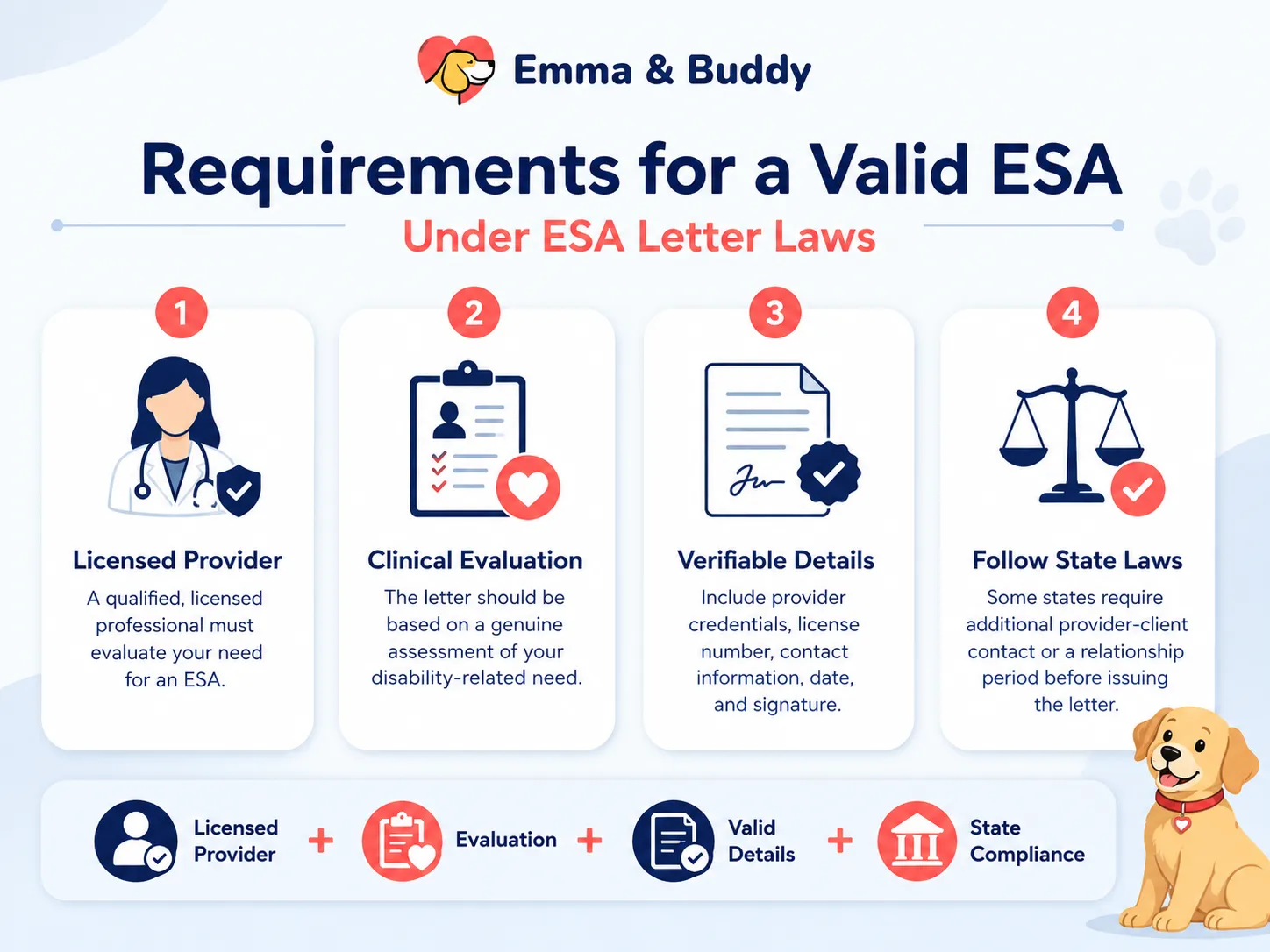
Regardless of your state, several core requirements help distinguish a legitimate ESA letter from a document that may not be accepted.
Get Evaluated by a Licensed Professional
An ESA letter should come from a qualified professional who is legally licensed to practice, such as a licensed therapist, counselor, psychologist, psychiatrist, or physician. The provider must evaluate your situation and determine that you have a disability-related need for the emotional support animal.
Include Verifiable Provider Information
A valid ESA letter should include the provider’s name, professional credentials, license number, contact information, issue date, signature, and a statement explaining the disability-related need for the animal. Missing or unverifiable information can lead to questions or delays from a housing provider.
Provider Must Follow State ESA Laws
The provider must comply with the licensing and telehealth requirements that apply in their state. Some states also impose specific rules regarding the provider-client relationship before an ESA letter can be issued. These requirements can affect whether the letter is considered valid.
Meet State-Specific 30-Days Relationship Requirements
Certain states have additional requirements before a provider can issue an ESA letter. In states such as Arkansas, California, Iowa, Louisiana, and Montana, applicable rules may require an established therapeutic relationship or a specific period of interaction between you and the provider. This means a single consultation may not be sufficient when state law imposes additional requirements.
Getting an ESA Letter Under State Laws: Step-by-Step
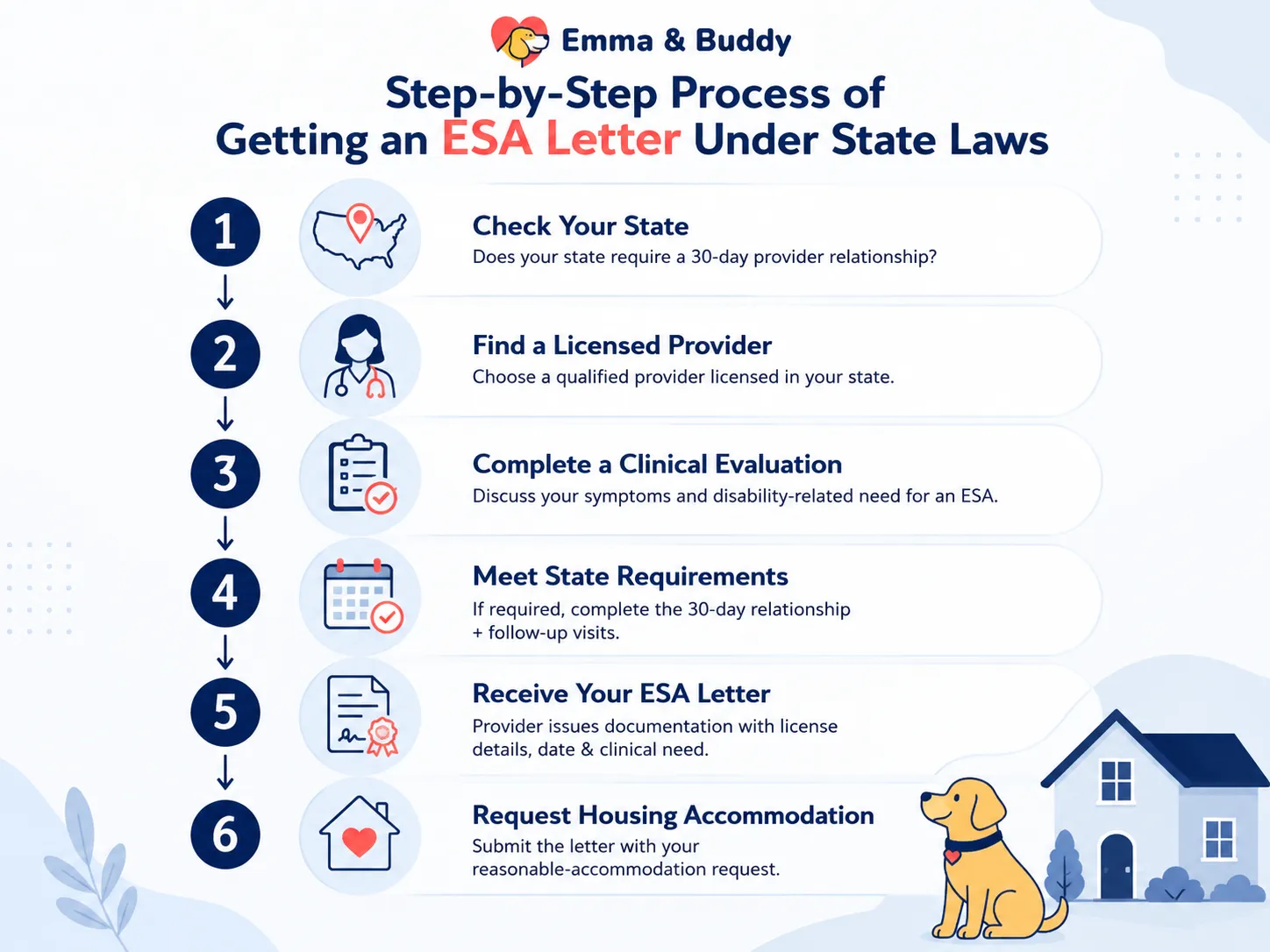
Step 1: Identify Your State’s ESA Letter Laws
Start by confirming whether your state is one of the five with a 30-day relationship requirement, since that determines your realistic timeline.
Step 2: Find a Qualified Licensed Provider
Look for a therapist, counselor, or physician licensed in your state who is willing to conduct a real clinical evaluation, not just sign a form.
Step 3: Complete the Required Clinical Evaluation
Be honest and thorough about your symptoms and how the animal supports your day-to-day functioning this evaluation is the foundation of a legitimate letter.
Step 4: Meet Any State-Specific Relationship Requirement
If you’re in one of the five 30-day states, plan for an initial visit and at least one follow-up before the letter can be issued.
Step 5: Receive Your ESA Documentation
Once your provider has everything state law requires, they can issue a letter containing their license information, the date, and a clear statement of your disability-related need.
Step 6: Request a Housing Accommodation
Submit the letter to your housing provider as part of a formal reasonable-accommodation request, and be prepared for a short back-and-forth if they have follow-up questions permitted under the FHA.
ESA Letter Laws and Processing Time
In the 45 states without a waiting-period law, timing depends mostly on your provider’s availability and how long a thorough evaluation takes don’t assume same-day issuance is guaranteed just because the state doesn’t require a delay.
If you’re in Arkansas, California, Iowa, Louisiana, or Montana, build the full 30 days into your planning from the moment you start working with a new provider.
Because moving dates, lease deadlines, and housing accommodation requests often move faster than paperwork does, it’s worth starting the provider relationship well before you actually need the letter in hand especially if a follow-up appointment is required.
Common Mistakes When Following ESA Letter Laws
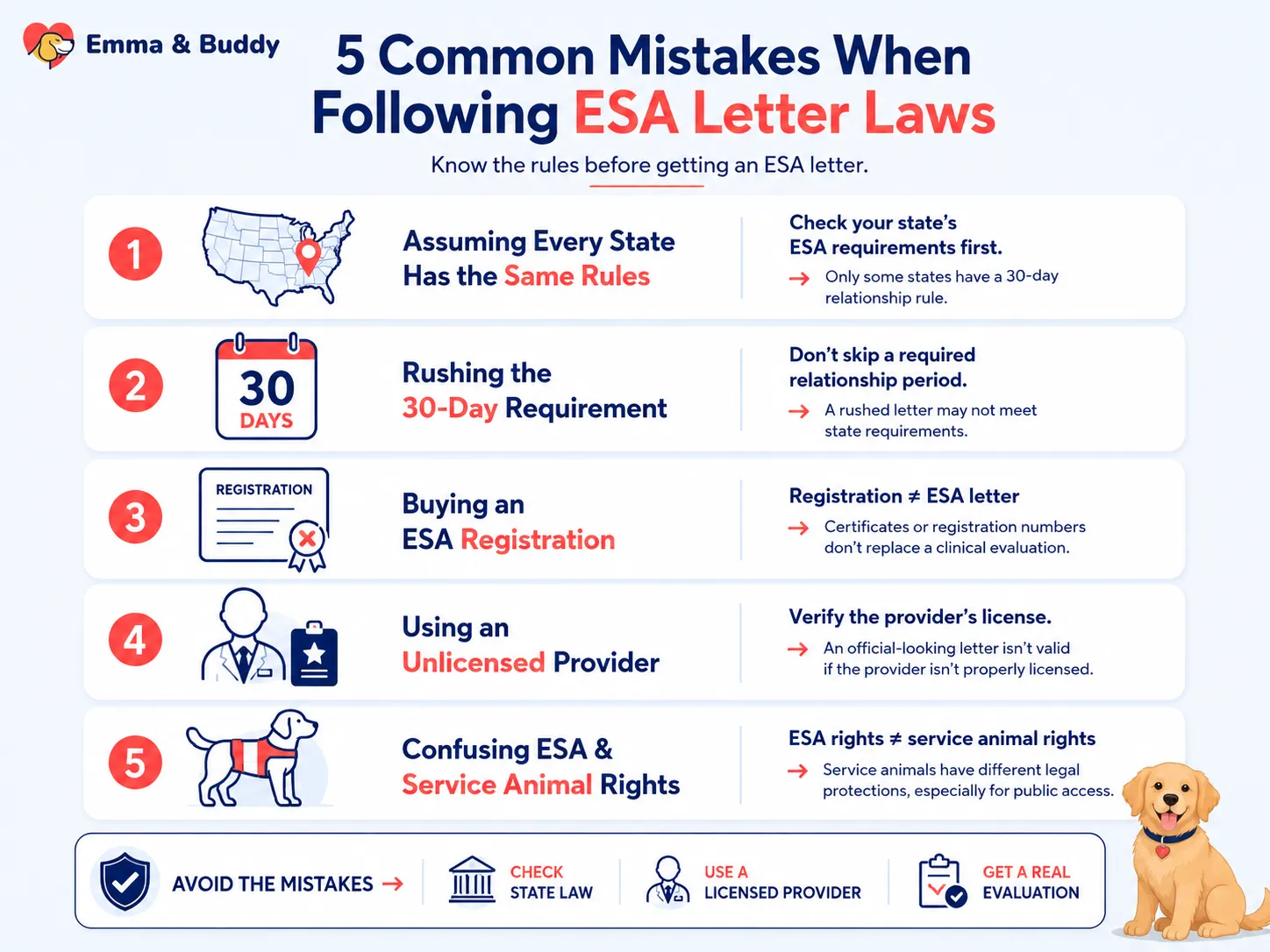
Assuming All States Have the Same ESA Laws
Only five states currently impose a 30-day relationship requirement, assuming your state is one of them and without checking can throw off your timeline.
Overlooking the 30-Day ESA Requirement
Trying to rush a letter in a 30-day state produces documentation that doesn’t meet the legal standard and can be challenged.
Buying an ESA Registration Instead of Evaluation
A registration number or certificate from an online database isn’t a substitute for a genuine clinical evaluation and carries no legal weight on its own.
Using an Unlicensed Provider
If the person writing your letter isn’t actually licensed in your state, the documentation isn’t valid no matter how official it looks.
Confusing ESA and Service Animal Rights
ESAs and service animals have different legal protections; assuming ESA status gives you the same public-access rights as a trained service animal can lead to real conflicts.
Conclusion
Getting an emotional support animal letter right means understanding two layers of law: the federal Fair Housing Act protections that apply nationwide and the state-specific requirements that may affect how and when you can obtain valid documentation. In particular, Arkansas, California, Iowa, Louisiana, and Montana have 30-day relationship requirements that can affect the timing and provider relationship needed for an ESA letter.
Skipping these requirements or relying on an online registration service instead of receiving a genuine clinical evaluation can lead to wasted money and documentation that may not meet the rules governing your state.
The good news is that once you understand your state’s requirements, the process is straightforward. Work with a properly licensed provider, discuss your needs honestly during a legitimate evaluation, and allow enough time to meet any applicable state requirements. Whether you can request an ESA letter now or need to establish a 30-day provider relationship first, following your state’s ESA letter laws can help you avoid unnecessary delays and protect your housing accommodation rights.






 Ask ChatGPT
  Ask Claude
  Ask Perplexity