

How to get a legitimate ESA letter comes down to one thing: a licensed clinician has to evaluate you.
A real letter documents a disability-related need for an emotional support animal. It is not a certificate, an ID card, or a registry entry. Many sites sell instant letters, and housing providers often reject them.
This guide explains what the letter is and what a valid one includes. It covers the evaluation, the kinds of letters that get rejected, and how to start.
Nothing here guarantees approval, because housing providers review each request on its own facts.
How to Get a Legitimate ESA Letter: What the Letter Is
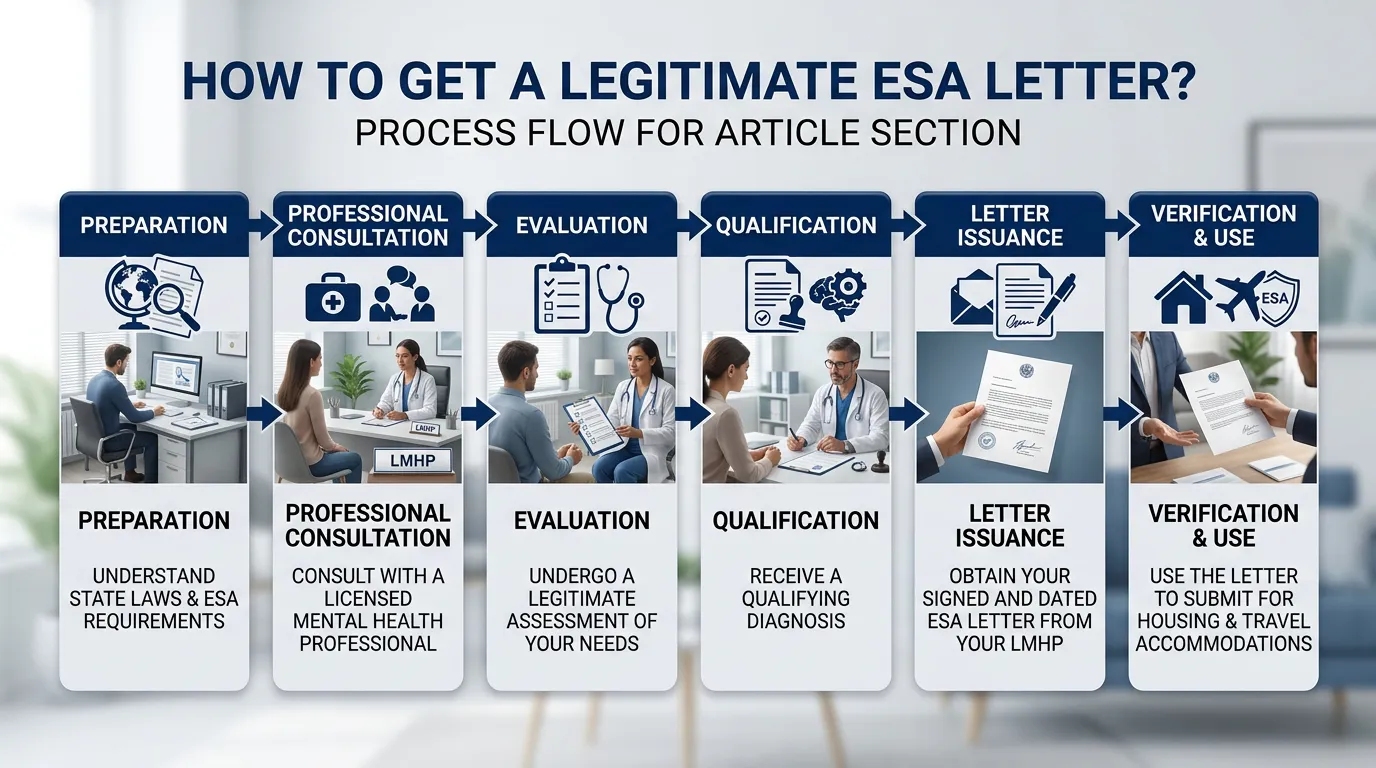
An ESA letter is written documentation from a licensed clinician. It states that you have a disability-related need for an assistance animal in housing. You give it to a landlord or a campus housing office when you ask for a reasonable accommodation. The learn-more page on how to get an ESA letter shows the steps with Emma & Buddy.
The letter supports a request. It does not force anyone to say yes. Under fair housing rules, a housing provider can review the request. They can ask for reliable documents. Then they can decide based on the facts. You can read the federal rules in HUD’s guidance on assistance animals.
What a Legitimate ESA Letter Is Not
A legitimate letter is not a registration. There’s no official national ESA registry. So a certificate or ID card from a registry site doesn’t carry any legal weight. It is also not a service animal document. An ESA does not get public access rights in stores or restaurants.
Requirements and the Evaluation
The letter needs to come from a licensed professional who has actually evaluated you. That could be a psychologist, a psychiatrist, or a licensed clinical social worker. It could also be a licensed professional counselor or another licensed clinician who treats your condition. Life coaches, peer counselors, and unlicensed providers do not qualify.
What a Valid Letter Includes
Housing providers look for clear, reliable details. A strong letter usually shows:
-
The clinician’s name, license type, license number, and issuing state
-
Official letterhead, a signature, and a recent date
-
A statement that you have a disability-related need for the animal
-
A short explanation of how the animal supports that need
The letter does not need to list your diagnosis or share your medical records. A landlord generally has no right to ask for those details.
What the Evaluation Looks Like
The evaluation is a real clinical conversation, often by video or phone. The clinician asks about your symptoms, your history, and how an animal helps you day to day. Come ready to talk about specific situations. For example, you might explain how your dog’s presence helps you settle after a panic episode.
The clinician decides whether an ESA is clinically appropriate for you. Sometimes the answer is no. That is why a legitimate service cannot promise approval before you are evaluated.
Who Can Write the Letter
Several licensed professionals can write a valid letter. They must treat or evaluate you for a condition they’re trained to handle. You might work with a psychologist, psychiatrist, licensed clinical social worker, or licensed professional counselor. Sometimes a physician or nurse practitioner can help too. What matters is the license, the state, and a real evaluation. A title alone does not make a letter valid.
If you already have a therapist, ask them first. They know your history and can speak to your needs. If you do not have a clinician, a telehealth service that connects you with a licensed professional in your state is a common route.
Why a Live Evaluation Matters
An evaluation shows that a clinician considered your situation before signing. It gives the housing provider a reason to trust the letter. It also protects you, because a letter that rests on a real conversation is far easier to defend if someone questions it. A form alone, with no clinician involved, does not give you that.
How to Check a Clinician’s License
The clinician should hold an active license in your state. Look up the name and license number on your state licensing board’s website. A legitimate service shares those details openly. Check this before you pay, not after.

What Gets Rejected: Instant Letters and Registry Junk
Most rejected letters share the same flaw. Nobody documented a real evaluation. Housing providers see the same patterns over and over, and they know what to look for.
Instant Letters
An instant letter arrives within minutes of a checkout and a short form. No clinician spoke with you. These letters get rejected often, and a rejection can delay your housing plans. If a site promises a letter in minutes, treat it as a warning.
Pet Registries and Certificates
Registries sell certificates, vests, and ID numbers. None of these replace a clinician’s letter. They are not required, and housing providers do not treat them as proof of a disability-related need.
Other Common Problems
-
The clinician is not licensed in your state
-
The letter has no license number, signature, or date
-
The letter is old and has not been updated
-
The site promises approval or a guaranteed result
-
The letter says nothing about your need for the animal
A licensed clinician spends real time evaluating you, so a legitimate letter involves professional work. A site that skips the clinician is usually not offering a legitimate evaluation.
Red Flags Before You Pay
You can spot most problem sites in a few minutes. Look at how the service describes itself and what it promises.
-
It promises a letter in minutes, or approval before you talk to anyone
-
It offers certificates, vests, or registry numbers as part of the package
-
It does not name the clinician or list a license number
-
It advertises a free letter
-
It claims your landlord must accept the letter
A legitimate service does the opposite. It explains that a clinician will evaluate you, says approval is not guaranteed, and gives you a way to verify credentials. If a site pressures you to buy quickly, step back and compare other options.
Why Rejections Happen
A housing provider can decline a request for several reasons. The letter might be missing clear details. The clinician may not be licensed where you live. Or the paperwork might read like a form template. Sometimes the request itself falls outside what the housing provider must grant. Understanding these reasons helps you fix a letter instead of starting over.
If a Landlord or College Pushes Back
Ask the housing provider what they need in writing. A campus can request documentation and apply its own process, so contact the campus disability or housing office early. If the letter is missing a detail, ask your clinician to fix it. A denial can sometimes be reviewed, and you can contact HUD if you believe your fair housing rights were violated.
Airlines and Travel
ESA air travel rules changed. Do not count on cabin access for an ESA, and check the airline’s current policy before you book. We cover travel in a separate Emma & Buddy guide.
How to Start
Here is the short path for how to get a legitimate ESA letter:
-
Decide whether your situation fits. You need a disability-related need for the animal.
-
If you already see a therapist, ask whether they can evaluate you for an ESA letter.
-
If you do not have a clinician, pick a service that connects you with state-licensed professionals and a live evaluation.
-
Check the clinician’s license on your state board’s website.
-
Complete the evaluation and review the letter for credentials, signature, and date.
-
Share the letter with your housing provider and keep a copy.
What to Prepare Before Your Evaluation
A little preparation makes the evaluation more useful. Write down when your symptoms started and what treatment you have tried. Note the daily situations where your animal helps, such as sleep, travel to work, or time alone at home. If you have past records from a doctor or therapist, bring them, but you do not have to share more than you are comfortable with.
Also think about your housing situation. Know your landlord’s or campus’s request process, and ask whether they use a specific form. Some housing providers ask for the letter plus a short accommodation request. Having both ready saves time.
What to Expect After You Receive the Letter
Read the letter carefully before you send it. Confirm that your name, the clinician’s license details, the signature, and the date are all correct. Send it with your written accommodation request, and keep copies of every message. Housing providers may reply with questions or ask for a standard form. Answer them promptly and politely.
Housing providers usually like recent letters, and many want one dated within the past year. If yours is older, ask your clinician for an update. The housing provider still makes the final call, and it can take a while.
Emma & Buddy connects you with licensed clinicians who evaluate each person individually. Approval is not guaranteed.
When you are ready, start your registration to begin the evaluation.





 Ask ChatGPT
 Ask Claude
 Ask Perplexity