

If you are working out what to do if your landlord rejects an ESA letter, start with the reason for the rejection. Some denials come from a fixable gap in the paperwork. Others come from a housing provider who does not know the fair housing rules.
This page walks through the process in order, from what the letter is to how to respond when a landlord stalls or says no.
Want an ESA letter? Emma & Buddy connects you with licensed therapists who check if one fits your situation. Their review can help support your request. Still, no letter or landlord response is guaranteed.
What to Do If Your Landlord Rejects an ESA Letter: The Short Answer
Ask for the reason in writing. Check your ESA letter for housing against the standards below. Fix any gap with your clinician, then send the request again. If the housing provider keeps stalling or refuses without a valid reason, contact a fair housing agency or file a complaint with HUD.
Each step is explained in the sections that follow.
What an ESA Letter Is in Housing
An ESA letter is a document from a licensed mental health professional.
It states that you have a disability-related need for an assistance animal in your home. In housing, it supports a reasonable accommodation request under the Fair Housing Act. It is not a pet registration, an ID card, or a certificate for your animal.
Under fair housing rules, an assistance animal is not treated as a pet. Some states also bar pet fees and pet rent for assistance animals, so check your state’s rules.

Housing providers look for a few things in a letter. It should come from a clinician licensed in your state, and that clinician should have evaluated you. It should be on letterhead with a license number and contact details, carry a current date, and state your disability-related need without listing a diagnosis. A well-prepared ESA letter for housing covers each of these points.
What a Landlord or Housing Provider Can Ask
A landlord can ask for reliable information if your disability or your need for the animal is not obvious. Questions are not a rejection, and they do not mean your case is weak. Reasonable requests include:
-
A letter from a licensed professional that documents a disability-related need for the animal.
-
A way to verify that the clinician is licensed and that the letter is real.
-
Information about the specific animal’s conduct, such as past incidents that point to a direct threat.
-
Reasonable care rules, such as waste cleanup and noise limits, that apply to any tenant.
A landlord can also deny a request in limited cases. Examples include an animal that poses a direct threat to others, an animal that would cause major damage that cannot be reduced, or a request that creates an undue burden. The Fair Housing Act also exempts some properties. These include certain owner-occupied buildings with four or fewer units and single-family homes rented without a broker.
State and local rules can add to these protections. Our guide to ESA letter laws by state covers the differences, including response timelines in some states.
What a Landlord Cannot Demand
A housing provider generally cannot ask for your diagnosis, your medical records, or details of your treatment. The letter only needs to document the need. A landlord also cannot require any of the following:
-
A specific form, a notarized statement, or a registry number.
-
A pet deposit, pet fee, or monthly pet rent for the assistance animal.
-
A denial based only on breed or size, without evidence about your individual animal.
-
A response that punishes you for asking, such as threats, new fees for other services, or a notice to leave.
You can still be responsible for actual damage the animal causes, as any tenant would be. To read the agency’s own explanation, see HUD’s assistance animals guidance.
None of this means every landlord must say yes to every request. Housing providers can evaluate each request under fair housing rules, and a denial with a valid reason is allowed.
How to Send the Letter
How you send the letter affects how easy it is to resolve a dispute later. Follow these steps:
-
Send the request in writing, by email or through the tenant portal, so you have a dated record.
-
State that you are requesting a reasonable accommodation for an assistance animal, and attach the letter.
-
Leave out your diagnosis and treatment details. The letter already covers the need.
-
Add helpful animal information, such as vaccination records and a short description of the animal’s behavior.
-
Ask for a response by a reasonable date, and keep copies of everything you send.
Sending the request before you sign a lease or move in is easier. You can still ask after move-in if your need arises later.

Keep your tone calm and factual. Frame the message as a request to start a conversation, not a list of demands.
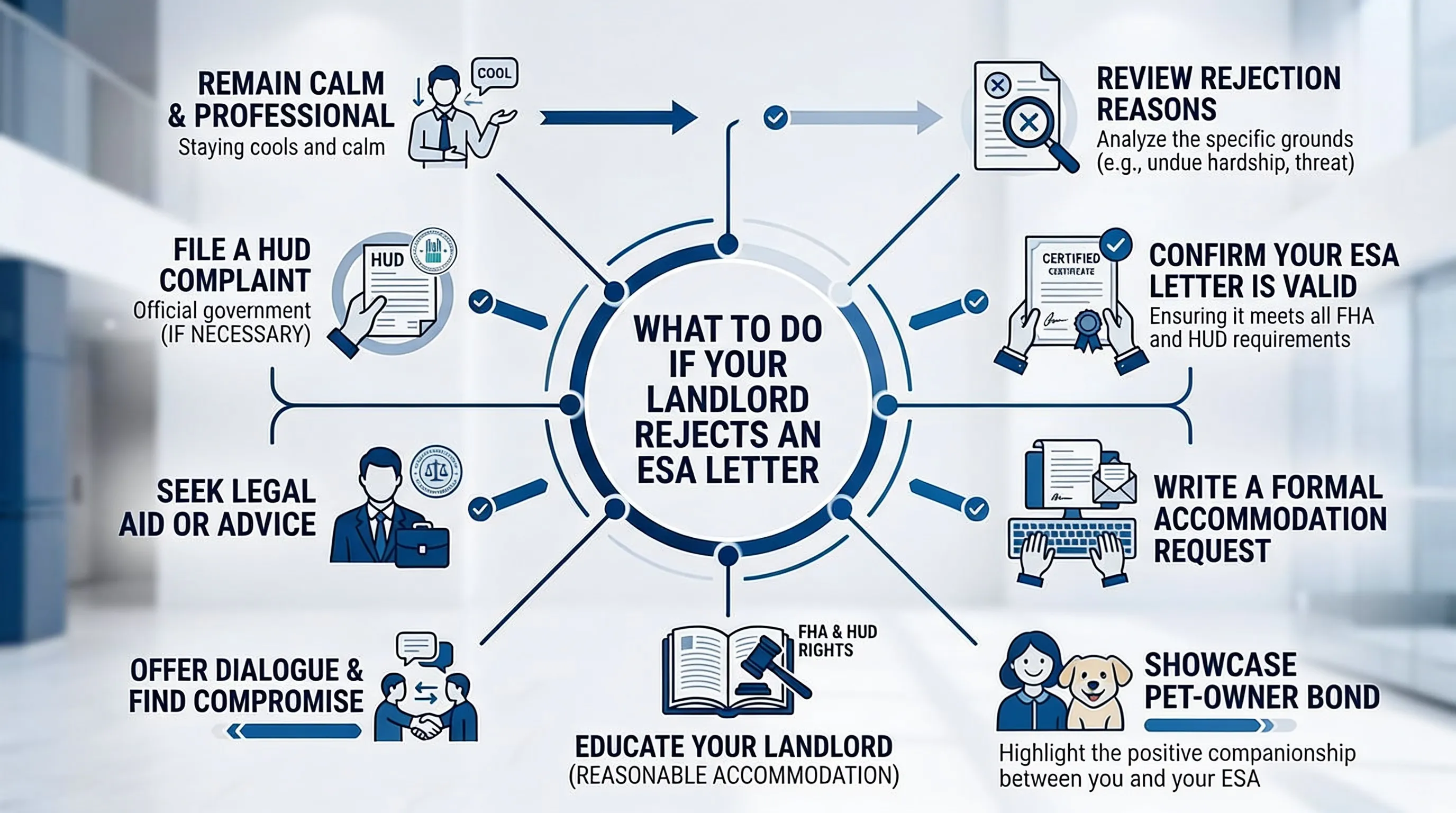
What to Do If Your Landlord Rejects an ESA Letter or Stalls
A stall is a delay with no answer. A rejection is a clear no. The first moves are the same for both.
Step 1: Ask for the Reason in Writing
If the answer came by phone or in person, send a short email asking the landlord to state the reason for the denial or delay. A written reason shows you whether the problem is the letter, the animal, or the landlord’s misunderstanding of the rules. Save the reply with the date.
Step 2: Check the Letter
Compare your letter with the standards above. Instant letters and pet registries get rejected often, because they usually involve no real evaluation by a licensed clinician. If your letter came from one of those sources, a clinician evaluation is the better path. Our ESA and service dog FAQs explain what housing and school reviewers expect.

Step 3: Respond and Reopen the Conversation
If the landlord named a gap, ask your clinician to address it and send the updated letter. If the concern is about the animal, answer it with records, references, or a signed agreement to cover damage. If the landlord charged a pet fee, point out that assistance animals are not pets under fair housing rules. Keep every message polite and in writing.
Step 4: Escalate if the Stall Continues
If the landlord keeps delaying or refuses without a valid reason, you have several options:
-
Contact a local fair housing organization or your state’s fair housing agency.
-
File a complaint with HUD. The deadline is one year from the date of the discriminatory act, so note the date of the denial right away.
-
Speak with a tenant attorney or a legal aid office about your case.
Bring your timeline, the request you sent, the letter, and every written reply. A clear record is the strongest tool you have.
Common Reasons a Landlord Rejects an ESA Letter
Knowing the likely reason helps you pick the right fix. Most rejections fall into a few groups.
-
The letter looks unverifiable. It has no license number, no contact details, or no sign that a clinician in your state evaluated you.
-
The letter came from an instant service or registry. Landlords see these often and tend to doubt them.
-
The landlord misunderstands the rules. Some housing providers treat an assistance animal like a pet and apply pet policies that do not fit.
-
The animal raises a concern. A documented bite history or a record of serious damage can lead to a denial.
-
The property is exempt. Some small owner-occupied buildings and certain single-family rentals fall outside the federal rules.
Each reason has a different response. A paperwork gap calls for a corrected letter. A misunderstanding calls for a calm, written explanation. An exempt property may call for a conversation about state rules or a different housing option.
Mistakes That Weaken Your Request
A few habits make a dispute harder to win. Avoid them if you can.
-
Accepting a verbal denial without asking for the reason in writing.
-
Sending long, angry messages. Short and factual messages work better.
-
Sharing your diagnosis or treatment notes when the landlord only needs the letter.
-
Waiting too long to act. The HUD filing deadline is one year, and records are easier to gather while events are fresh.
-
Moving the animal in before the request is settled. This can cause problems if the landlord objects.
Not sure which group your case falls into? A fair housing organization can review your documents. A licensed therapist can also tell you if your letter reflects a real evaluation.
Colleges and Air Travel
If your housing provider is a college, the campus can ask for documentation and apply its own process. That process is not a guarantee, and timelines vary. See our page on an ESA letter for college housing for details.
This page covers housing only. ESA air travel rules have changed, and we cannot promise cabin access on any airline. Check the airline’s current policy and browse our ESA guides for travel information.
How to Start
Maybe your letter came from an instant service or a registry. Maybe you do not have a letter yet. Either way, the next step is an evaluation with a licensed therapist. The therapist decides if an ESA letter fits your situation, and approval is not guaranteed.
If you are still asking what to do if your landlord rejects an ESA letter, a licensed therapist evaluation is the next step. You can start your evaluation online, or read how the process works first.






 Ask ChatGPT
 Ask Claude
 Ask Perplexity