

ESA Letter for Apartments ESA Letter for Apartment: What You Need to Know
An ESA letter for apartment housing protects your right to live with your emotional support animal. This holds even in buildings with no-pets policies. The Fair Housing Act requires covered landlords to consider ESA requests. Tenants with ESAs can ask for housing changes. You need a legitimate letter from a licensed mental health professional. It documents your need. This protection applies to most rental properties, even those that charge pet fees or deposits.
This guide shows you how to get a valid ESA letter. It explains which documents your landlord can request. It also covers your rights as a tenant. You’ll learn how to approach property managers about your accommodation request. You’ll also see what makes an ESA letter legitimate. The guide also flags landlord demands that cross legal boundaries.
Understanding ESA Letter for Apartment: Why Do You Need One?
An ESA letter is documentation from a licensed mental health professional. It supports your need for an emotional support animal in housing. See how an ESA letter for housing can support a reasonable accommodation request.
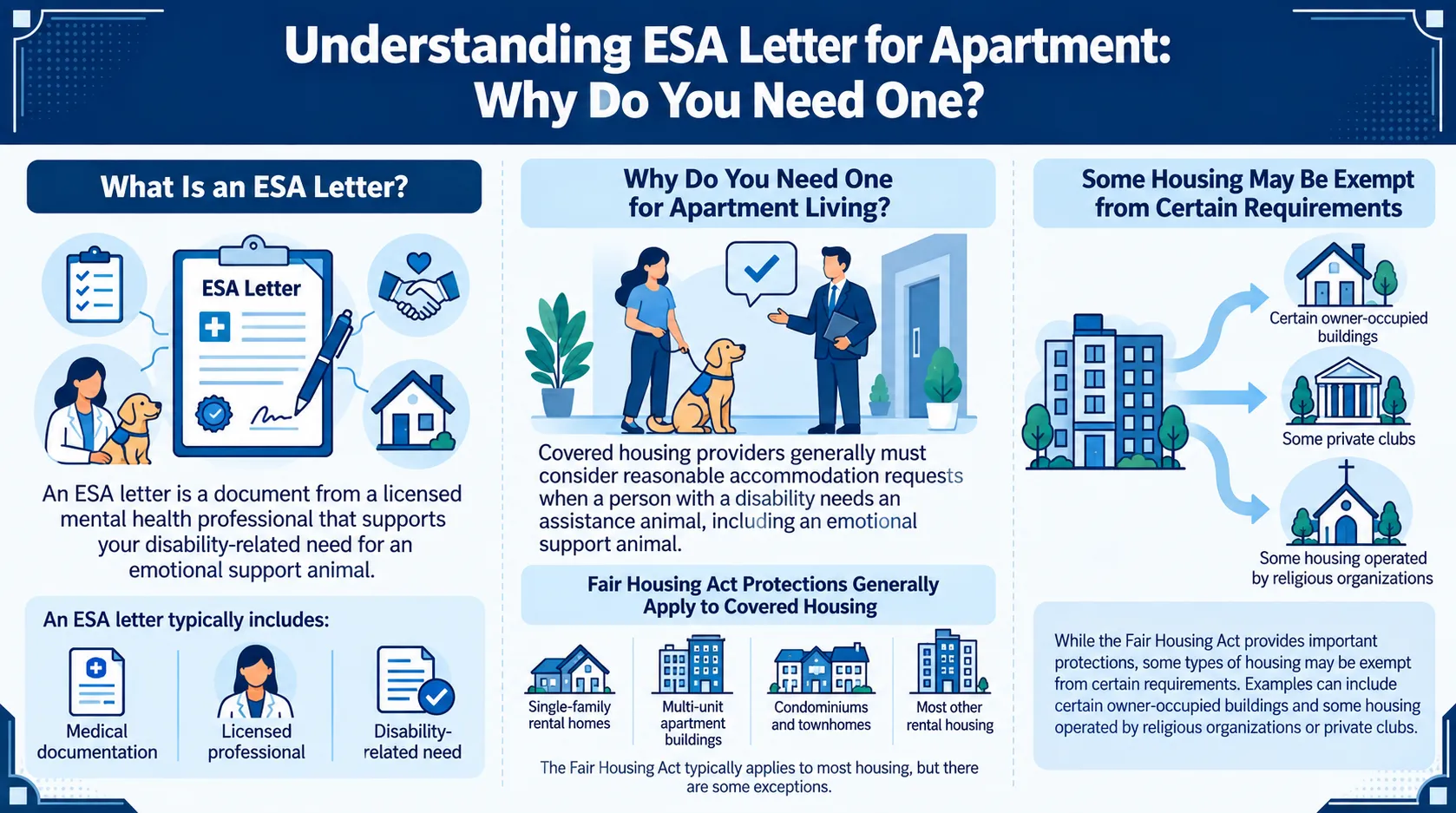
The letter can support your reasonable accommodation request. It documents your disability-related need for an assistance animal. In covered housing, the request may let you keep an assistance animal despite strict pet policies.
Legal Definition and Purpose
The letter must come from a healthcare provider licensed in your state. That provider must build a therapeutic relationship with you through a proper evaluation. Be cautious of websites offering instant ESA letters without a genuine consultation.
Your provider documents your disability. They also note that your ESA eases symptoms or provides needed support. This can back a reasonable accommodation request for an assistance animal when you have a disability-related need.
How ESA Letters Differ from Pet Policies
Regular pets face landlord discretion, breed restrictions, weight limits, and monthly pet rent. Assistance animals in covered housing may skip the pet limits that apply to ordinary pets.
Landlords typically cannot charge pet deposits or extra fees for your approved ESA. You remain responsible for actual damage your animal causes. Landlords cannot charge preventive fees.
Federal Protections Under Fair Housing Act
The Fair Housing Act generally requires covered housing providers to consider reasonable accommodation requests. People with disabilities who need assistance animals can make these requests. The law applies to most rental housing, although some properties are exempt.
Buildings with four or fewer units are typically exempt if the landlord lives in one unit. Some single-family homes may also follow different rules. So may properties owned by private clubs or religious organizations.
How to Obtain a Legitimate ESA Letter
Working with Licensed Mental Health Professionals
Start with a licensed mental health professional, such as a therapist, psychologist, or psychiatrist. Choose one who holds an active license in your state. That license lets them perform the evaluation and write the documentation.
The evaluation should include a thorough assessment of your mental health needs. Expect to talk about your mental health history and current symptoms. You will also cover how an emotional support animal fits your treatment plan. This isn’t a quick transaction but a professional medical evaluation.
Online vs. In-Person Evaluations
Both online and in-person evaluations can produce a legitimate ESA housing letter. What matters is that a properly licensed professional conducts them. Reputable online platforms like Emma and Buddy connect you with licensed mental health professionals. These telehealth evaluations meet legal standards.
Online evaluations are convenient. They should still involve a real consultation, not just a payment form. Understanding how the telehealth evaluation process works helps you tell proper services from those that cut corners.
Red Flags to Avoid When Getting an ESA Letter
Avoid websites offering instant letters without any consultation. These letters are not legally valid. They won’t hold up when your landlord checks the documentation.
Watch for services that skip license checks. Also watch for those that won’t let you speak with the professional. If a site promises a letter in minutes and never asks about your mental health, it’s selling fake documentation.
Be wary of providers who lack a license in your state. Also avoid those who refuse to list their license details on the letter. Landlords can and do verify credentials. A fraudulent letter can lead to a denial of your accommodation request.
What an ESA Housing Letter Should Document
Required Components and Legal Language
An ESA housing letter should name the healthcare professional. It should show their professional relationship with you. It should also confirm your disability-related need for the assistance animal.
The letter should give reliable information showing that you have a disability and a disability-related need for the assistance animal. The letter should state that your emotional support animal helps your mental health. It should show how the animal eases your disability symptoms.
Keep the focus on your need for accommodation, not on details about your diagnosis or treatment plan. Landlords need to understand the link between your disability and the animal, not your complete medical history.
Provider Credentials and Contact Information
Your provider’s contact information must appear on the letter so landlords can verify its authenticity if needed. This typically includes their phone number, email address, and practice address.
Since state-specific ESA laws determine licensing requirements, the letter should show where your provider holds their license. Platforms like Emma and Buddy connect you with licensed pros. These pros know ESA letter rules. They help your letter meet federal housing rules.
Documentation Best Practices
Your documentation should give reliable information about your current disability-related need for the assistance animal. Housing providers may ask for updated information when they reasonably need it to evaluate the accommodation.
Keep a digital copy and at least one printed copy in a safe place. You may need to provide the letter when applying for housing or if your landlord requests updated documentation.
Make sure all information is accurate and matches your current living situation. Any discrepancies between your letter and application materials can delay your accommodation request.
What Landlords Can Ask When Evaluating Your ESA Request
Housing providers have specific rights when reviewing your ESA accommodation request. Understanding what they can ask helps you prepare proper documentation and respond appropriately.
Permissible Questions About Disability-Related Need
Landlords can ask whether you have a disability-related need for the animal. This question focuses on whether the animal provides assistance or support related to your disability.

They may also request information about whether the animal helps with specific symptoms or limitations. However, they cannot demand detailed explanations of your medical condition or treatment history.
Documentation Requests Housing Providers May Make
Housing providers can request documentation from a licensed healthcare provider confirming your need for the ESA. This typically means an ESA letter for apartment accommodation that meets legal requirements.
They may ask for basic information about the animal’s behavior, including whether it is housebroken. Landlords can also inquire about the type of animal to assess any property or safety concerns.
If you have questions about what documentation satisfies these requirements, reviewing answers to common ESA questions can clarify the process.
Verification of Healthcare Provider Credentials
Landlords can check if your healthcare provider has a valid license. They can also check if your letter is real. This includes confirming the provider’s license number, type, and issuing state.
They can contact your provider to confirm the letter is legitimate and came from a genuine therapeutic relationship. This protects both parties from fraudulent documentation.
What Landlords Cannot Demand from ESA Accommodation Requests
Federal housing law protects you from intrusive requests when you submit an ESA letter for apartment accommodation. Understanding these boundaries helps you avoid unnecessary disclosures and illegal demands.
Protected Medical Information
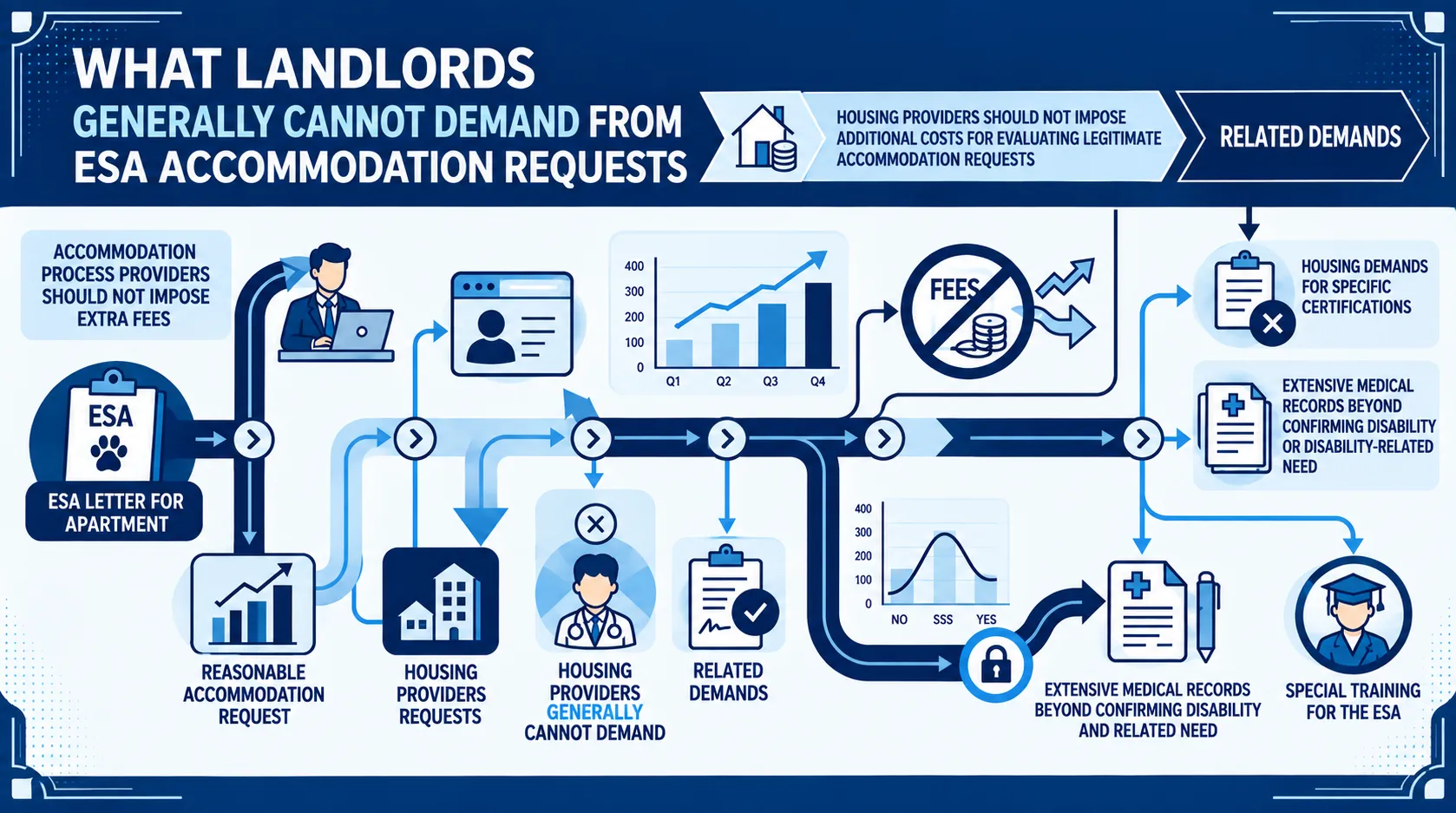
Landlords generally cannot ask for your specific diagnosis or detailed medical history. Your provider’s letter should confirm that you have a disability and need the ESA. Your exact condition stays private.
They typically cannot demand full medical records or require you to demonstrate your disability. The letter itself serves as sufficient documentation of your need.
Prohibited Documentation Requests
Housing providers usually cannot require specialized training or certification for emotional support animals. Unlike service animals, ESAs don’t need formal training credentials.
Landlords typically cannot require you to use a specific healthcare provider or ESA letter service. You have the right to choose your own licensed mental health professional.
They generally cannot charge you a separate fee simply to evaluate a reasonable accommodation request.
Limits on Animal-Related Demands
Housing providers generally cannot demand that the animal wear identifying vests, tags, or other markers. ESAs are not required to display special identification.
They should not demand more documentation than reasonably necessary to evaluate the accommodation request.
Landlords can ask about the animal’s behavior and whether it’s housebroken. They cannot impose arbitrary requirements beyond what’s needed to assess safety and property concerns.
Your Rights as a Tenant with an ESA Letter
If you have a disability-related need for an assistance animal, and fair housing protections cover your housing, you may have rights to a reasonable accommodation. Knowing these rights helps you make a request with confidence. It also helps you tell when a housing provider’s response is appropriate.
Protection from Pet Fees and Deposits
Under the Fair Housing Act, covered housing providers generally cannot charge pet fees, pet rent, or pet deposits for approved ESAs. Your emotional support animal is not classified as a pet but as a reasonable accommodation for your disability.
Many breed restrictions, weight limits, and species restrictions that apply to pets may not apply to legitimate ESAs in covered housing. Your ESA may be able to live with you even in buildings with no-pet policies, depending on the housing type.
According to HUD guidance, housing providers should review each reasonable accommodation request under the housing rules and the facts of the case.
When Housing Providers May Consider Animal-Related Concerns
Housing providers may consider whether a specific animal poses a direct threat to health or safety. They can also look at whether the animal would cause substantial physical damage that a reasonable accommodation cannot fix. They must base these decisions on objective facts about the specific animal, not assumptions about breeds or species.
You remain responsible for any actual damage your ESA causes to the property. Landlords cannot charge a deposit upfront, but they can bill you for repairs if your animal damages the unit beyond normal wear and tear.
Exemptions and Limitations to Fair Housing Protections
Some housing is exempt from Fair Housing Act requirements. Certain owner-occupied buildings with four or fewer units may be exempt from the Fair Housing Act’s requirements.
Certain single-family homes rented without a broker may also be exempt. Private clubs and religious organizations may have different rules regarding assistance animals, though many still choose to accommodate ESAs voluntarily.
Conclusion
An ESA letter for apartment housing links your mental health needs to your right to a reasonable accommodation. Get legitimate documentation from a licensed professional and communicate clearly. This lays the groundwork for living with the emotional support animal that supports your well-being.
Start by connecting with a licensed mental health professional who can evaluate whether an ESA fits your treatment. Once you have valid documentation, submit your accommodation request in writing. Be ready to answer reasonable questions about your need. Keep copies of all correspondence, and know your rights and responsibilities as a tenant with an ESA.
If you need an ESA letter for apartment housing, Emma and Buddy can connect you with a licensed mental health professional for an evaluation. Start your consultation today to take the next step toward requesting a housing accommodation.





 Ask ChatGPT
 Ask Claude
 Ask Perplexity