

Renting with an emotional support animal (ESA) does not have to mean losing your dream apartment or fighting your landlord for weeks. Renters and ESA letters go together under one federal law, the Fair Housing Act, which gives you the right to keep a legitimate support animal even in housing that says “no pets.” This guide walks through what a valid letter needs, when to ask for accommodation, how to talk to your landlord, and what to do if things get complicated. None of this is legal advice, and no guide can promise your request will be approved. What it can do is help you avoid the mistakes that cause otherwise valid requests to get denied.
If you are ready to move forward, Emma & Buddy’s ESA letters for rental housing service connects you with a licensed provider who can evaluate your situation and issue documentation that meets the standards landlords expect.
Renters and ESA Letters: What the Law Actually Protects
The Fair Housing Act (FHA) is the federal law that governs renters and ESA letters, including how to submit an ESA request to your landlord. It applies to almost every rental property in the country, including apartments, condos, and single-family rentals, with only a few narrow exceptions. Under this law, an emotional support animal is not treated as a pet. It is treated as a form of disability-related accommodation, similar to a ramp or a reserved parking spot near your unit.
Because an emotional support animal is not legally classified as a pet, different housing rules apply. In most cases, landlords cannot charge a pet deposit, monthly pet fee, or pet rent for an approved ESA. They also cannot deny a housing request simply because the animal exceeds breed or weight restrictions that apply to pets. These protections exist because an ESA is considered a reasonable accommodation for a person with a qualifying disability, not a pet covered by standard rental policies. Understanding your ESA housing rights and landlord responsibilities can help you recognize when a housing provider is following, or violating, federal fair housing law.
Reasonable Accommodation Protects Your ESA
At its core, the Fair Housing Act (FHA) enforces fair housing protections and accessibility requirements for renters and applicants through a powerful legal mandate known as reasonable accommodation. Under federal law, housing providers are legally obligated to modify or make exceptions to their standard rules, such as strict “no-pets” policies, when a tenant with a disability requires that exception to have an equal opportunity to use and enjoy their home.
Federal regulations explicitly define this mandate under 42 U.S. Code § 3604. It states that it is unlawful for any person to refuse to make reasonable accommodations in rules, policies, practices, or services when such accommodations are necessary to afford a person with a disability equal housing enjoyment. This statutory rule is the exact reason why a property manager must legally accommodate your Emotional Support Animal, regardless of any standard pet bans or restrictions the building enforces.
Federal Enforcement of Fair Housing Rights
Two primary federal agencies collaborate to uphold and enforce these FHA regulations across the United States:
-
The Department of Housing and Urban Development (HUD): As the primary administrative oversight body, HUD handles complaints, outlines compliance parameters, and details the specific accessibility and accommodation rights guaranteed to individuals with disabilities.
-
The Department of Justice (DOJ): While HUD manages administrative complaints and localized enforcement, the DOJ steps in to litigate systemic issues, handle civil rights referrals, and enforce fair housing laws when an ESA discrimination case moves directly into the federal court system.
Renters and ESA Letters: What a Valid Letter Must Include
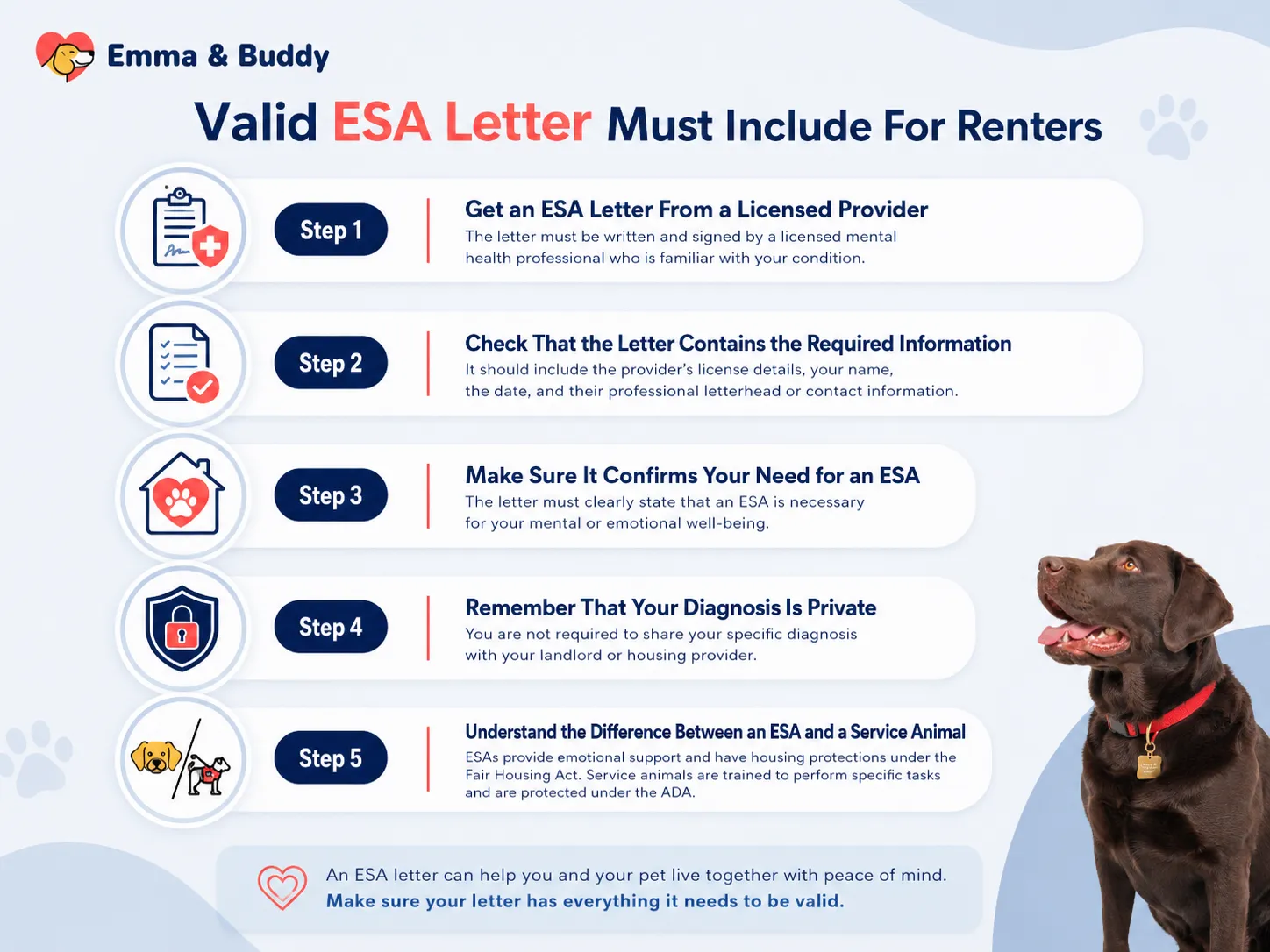
A valid ESA letter is short, but every line in it matters, including how to get an ESA letter. It should come on the letterhead of a licensed mental health professional, such as a therapist, licensed clinical social worker, psychologist, or psychiatrist. Some states also allow primary care physicians to write these letters, but a licensed mental health provider is the safest and most widely accepted source.
Step 1: Get an ESA Letter From a Licensed Provider Start by obtaining your ESA letter from a licensed healthcare professional who is qualified to assess your mental or emotional health. The most widely accepted providers include licensed therapists, psychologists, psychiatrists, and licensed clinical social workers. In some states, primary care physicians may also issue ESA letters.
Step 2: Check That the Letter Contains the Required Information A valid ESA letter should be printed on the provider’s official letterhead and include their full name, license number, license type, state of licensure, signature, and the date the letter was issued. These details help demonstrate that the documentation comes from a licensed professional.
Step 3: Make Sure It Confirms Your Need for an ESA The letter should confirm that you have a qualifying disability under the Fair Housing Act and that your emotional support animal helps reduce one or more symptoms or effects of that disability. It should establish your need for a reasonable accommodation without disclosing unnecessary medical information.
Step 4: Remember That Your Diagnosis Is Private A legitimate ESA letter does not need to identify your specific diagnosis. Most healthcare providers intentionally leave out this information to protect your medical privacy while still meeting Fair Housing Act requirements.
Step 5: Understand the Difference Between an ESA and a Service Animal An emotional support animal provides therapeutic benefits through companionship and does not require specialized training. A service animal, by contrast, is individually trained to perform specific tasks related to a person’s disability and has broader public access rights under the Americans with Disabilities Act. Knowing this distinction can help you understand your housing rights and avoid confusion during the rental process.
Renters and ESA Letters: When Should You Submit Your ESA Letter?
One of the most common questions about renters and ESA letters is timing. Should you request accommodation before signing a lease, or wait until after you move in? There is no single right answer, but there is a smarter order for most situations.
- Request your ESA accommodation before signing the lease whenever possible. It gives the landlord time to review your documentation before you move in.
- Early requests help avoid misunderstandings and reduce the chance of conflicts that can arise if the landlord learns about your ESA after the lease has already been signed.
- If you receive an ESA recommendation or are diagnosed after moving in, you still have the right to request a reasonable accommodation under the Fair Housing Act.
- Submit your request as soon as you have your ESA letter. Delaying the request can complicate the process, especially if a landlord believes you have violated the property’s pet policy.
- Always make your request in writing and clearly state that you are requesting a reasonable accommodation under the Fair Housing Act. Written documentation helps create a clear record of your request.
- Requesting your accommodation before receiving a lease violation notice is the best way to resolve the matter cooperatively and avoid unnecessary legal or administrative issues.
Renters and ESA Letters: How to Talk to Your Landlord
-
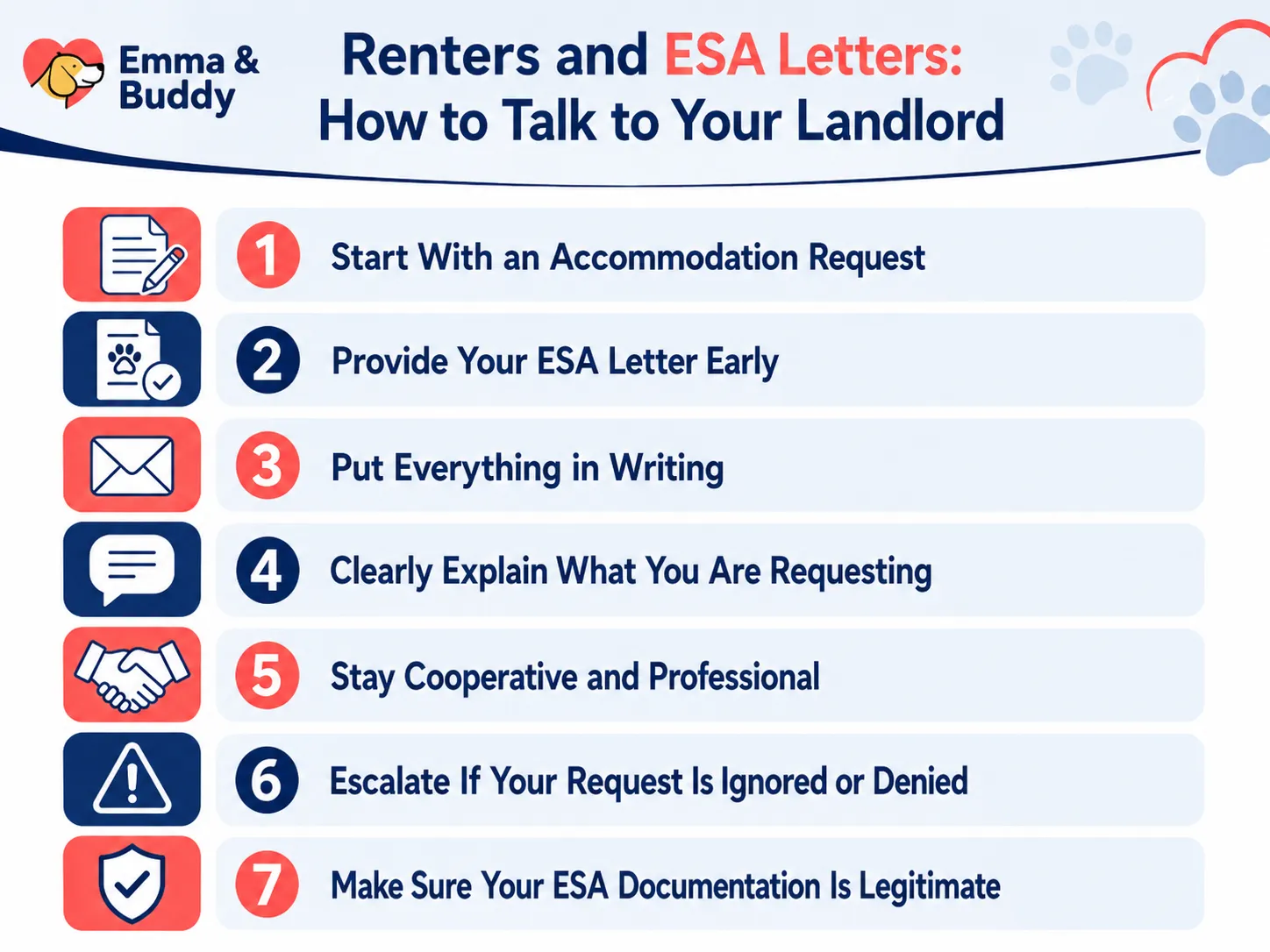
Start With an Accommodation Request Approach the conversation as a request for a reasonable accommodation under the Fair Housing Act, not as a negotiation or confrontation. Keep the discussion professional, clear, and focused on your housing rights.
-
Provide Your ESA Letter Early Share your valid ESA letter when making the request. Providing documentation upfront gives the landlord the information they need to review your accommodation request without unnecessary delays.
-
Put Everything in Writing Even if you speak with your landlord in person or by phone, follow up with an email or written letter. Written communication creates a clear record of when you made the request and what information was provided.
-
Clearly Explain What You Are Requesting State that you are requesting permission to keep your emotional support animal as a reasonable accommodation under the Fair Housing Act. Using direct and specific language can help prevent misunderstandings.
-
Stay Cooperative and Professional Many landlords are unfamiliar with ESA housing rules, especially independent landlords who manage only a few rental properties. A respectful and collaborative approach often resolves questions faster than immediately escalating the dispute.
-
Escalate If Your Request Is Ignored or Denied If a landlord refuses to consider your request or ignores it entirely, you may file a housing discrimination complaint with the U.S. Department of Housing and Urban Development (HUD). HUD investigates Fair Housing Act complaints at no cost to eligible tenants.
-
Make Sure Your ESA Documentation Is Legitimate Having a properly prepared ESA letter from a licensed provider can make the accommodation process smoother. Accurate documentation helps demonstrate that your request meets Fair Housing Act requirements and reduces the likelihood of disputes.
If you want help getting a properly formatted letter from a licensed provider before you approach your landlord, Emma & Buddy can walk you through the ESA housing letter process from evaluation to delivery.
Renters and ESA Letters: What Landlords Can and Cannot Ask
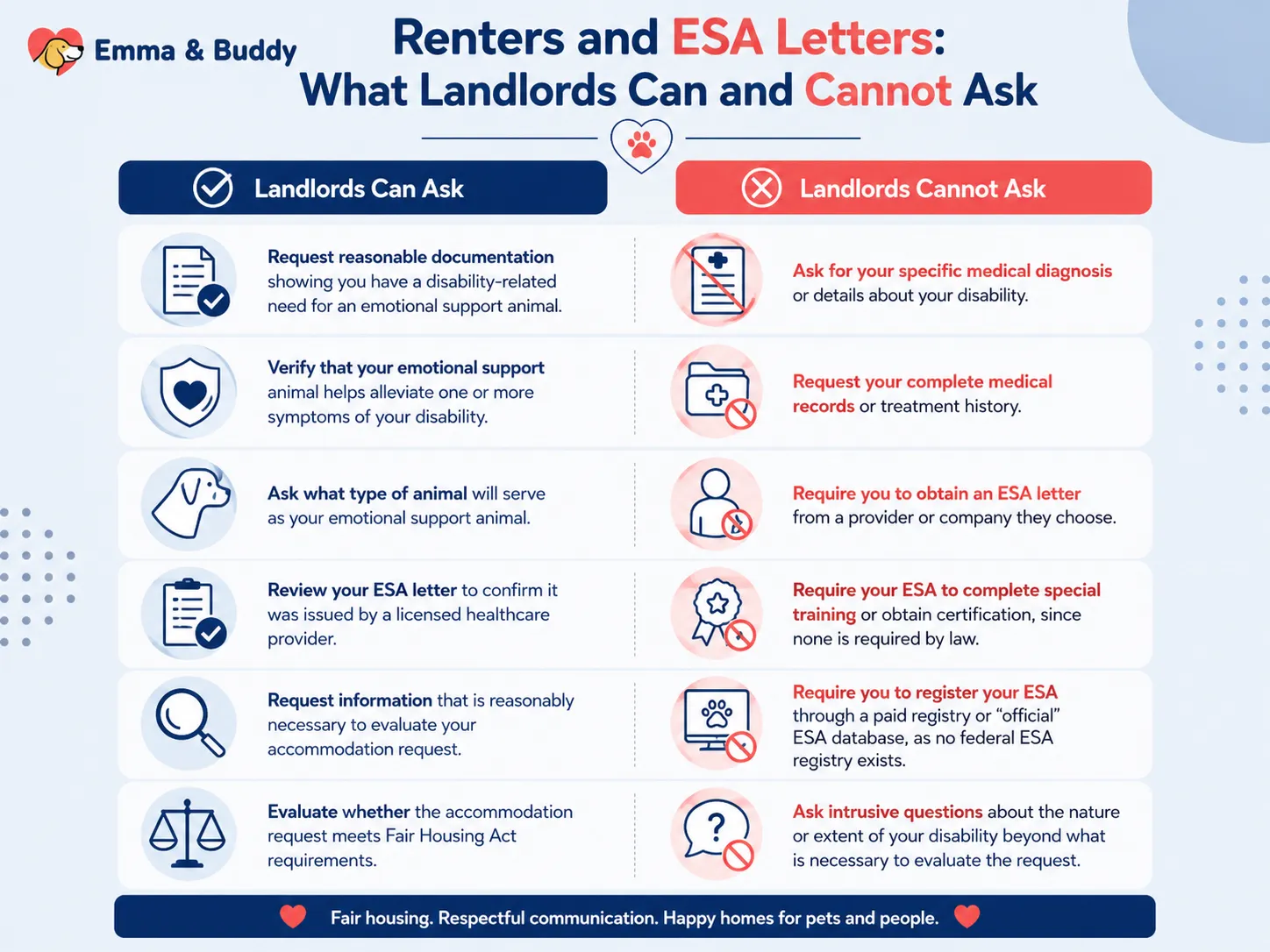
What Landlords Can Ask:
- Request reasonable documentation showing you have a disability-related need for an emotional support animal.
- Verify that your emotional support animal helps alleviate one or more symptoms of your disability.
- Ask what type of animal will serve as your emotional support animal.
- Review your ESA letter to confirm it was issued by a licensed healthcare provider.
- Request information that is reasonably necessary to evaluate your accommodation request.
- Evaluate whether your accommodation request meets Fair Housing Act requirements.
What Landlords Cannot Ask:
- Ask for your specific medical diagnosis or details about your disability.
- Request your complete medical records or treatment history.
- Require you to obtain an ESA letter from a provider or company they choose.
- Require your ESA to complete special training or obtain certification, as none is required by law.
- Require you to register your ESA through a paid registry or an “official” ESA database, since no federal ESA registry exists.
- Ask intrusive questions about the nature or extent of your disability beyond what is necessary to evaluate your accommodation request.
Renters and ESA Letters: Common Documentation Mistakes That Cause Denials
Most denials are not really about whether ESAs are legal. They happen because of paperwork problems that could have been avoided. The most frequent one is an ESA letter that comes from an online service with no real evaluation behind it. Letters generated instantly, with no consultation or clinical review, are the ones landlords are most likely to flag, and rightfully so.
| Common Mistake | Why It Can Cause Problems | How to Avoid It |
|---|---|---|
| Using an ESA letter without a real evaluation | Letters from services that provide instant approvals without a consultation or clinical review may be questioned by landlords. | Get an ESA letter from a licensed provider after a proper evaluation. |
| Missing provider information | A letter without details like a license number, credentials, signature, or date may appear incomplete or invalid. | Ensure the letter includes all required provider information. |
| Submitting an expired ESA letter | Outdated documentation can delay approval and may require you to restart the accommodation process. | Use a current ESA letter and update it when needed. |
| Making a vague accommodation request | A request that only says “I need an ESA” may not clearly explain the housing accommodation being requested. | Clearly state the animal type and that it supports a disability-related need. |
| Providing incomplete paperwork | Missing details can create unnecessary back-and-forth with landlords or property managers. | Submit accurate, complete, and up-to-date documentation from the beginning. |
Renters and ESA Letters: Handling a Denial or a Delay
-
Ask for the reason in writing. If your ESA accommodation request is denied, request a written explanation from your landlord. This helps you understand whether the denial is legally justified.
-
Know the limited reasons for a lawful denial. A landlord may deny an ESA request only in limited situations, such as when the animal poses a direct threat, the accommodation creates an undue financial or administrative burden, or your documentation does not establish a disability-related need.
-
Challenge an unexplained denial. If your landlord refuses your request without providing a valid reason or ignores it altogether, you may have grounds to pursue a fair housing complaint.
-
File a complaint with HUD if necessary. You can submit a housing discrimination complaint to the U.S. Department of Housing and Urban Development (HUD). In most cases, complaints must be filed within one year of the alleged discrimination.
-
Consider legal action if needed. You may also file a lawsuit in federal court within two years of the alleged denial, although many renters choose the HUD complaint process first because it does not require attorney fees or court filing costs.
-
Keep detailed records. Save your ESA letter, accommodation request, emails, letters, and notes from every interaction with your landlord. Thorough documentation can strengthen your case if the dispute escalates.
Conclusion
Renters and ESA letters do not have to be a source of stress if you approach the process in the right order. Understand your rights under the Fair Housing Act, get a properly documented letter from a licensed provider, and submit your request early and in writing. Most disputes come down to incomplete paperwork or a landlord who simply is not familiar with the rules, not an actual legal conflict. None of this guarantees an approval in every case, since every situation depends on your documentation and your housing provider’s specific circumstances, but following this order gives you the strongest possible starting point.
If you are ready to move forward, Emma & Buddy’s ESA housing letter service connects you with a licensed provider who can evaluate your situation and issue documentation that meets the standards landlords expect. Getting that step right is often the difference between a smooth conversation with your landlord and a drawn-out dispute, and it is the single most useful thing renters and ESA letters have in common when things go well.






 Ask ChatGPT
  Ask Claude
  Ask Perplexity