
ESA Letter for Dorms
An ESA Letter for Dorms can help you keep your animal with you on campus, but only if you ask early. Housing deadlines at most colleges arrive months before move-in day. A student who waits can lose both the room and the timeline.
Most pages on this topic sell letters and stop there. They rarely explain how a dorm request differs from a private rental. They skip which state the provider must be licensed in. They also say little about what to do when a school says no. This guide gives US students and parents a clear process. You’ll learn how to plan around housing deadlines, submit a request, and understand what schools can and can’t ask for. You’ll also know your next step if the school denies your request.
ESA Letter for Dorms vs. Off-Campus Rentals: What’s the Difference?

Both settings fall under the Fair Housing Act. A dorm request goes through the school’s disability or accessibility office. An off-campus request goes to a landlord or property manager.
An ESA Letter for Dorms adds steps. Colleges run their own assistance animal policies, forms, review committees, and housing deadlines. Section 504 of the Rehabilitation Act may also apply. Landlords usually have no formal process or fixed calendar.
| Factor | Dorms | Off-campus rentals |
|---|---|---|
| Who reviews | Disability office or committee | Landlord or property manager |
| Where rules come from | School policy plus federal law | Lease plus federal law |
| Typical timing | Set school deadlines | Usually flexible |
| Shared spaces | Bathrooms, roommates, floors | Often a private unit |
An emotional support animal in college dorm housing often affects roommates and shared bathrooms. The school may adjust your room or floor assignment. An ESA Letter for Dorms helps support that request, but the school still reviews it.
A rental usually gives the animal a private home under one lease. Renters can read how an ESA letter for off-campus housing works before they apply.
Do Colleges Have to Accept an ESA Letter for Dorms?
Colleges generally must consider and evaluate a request backed by reliable documentation, but they don’t have to approve every one. Must evaluate and must accept are different standards.
The Fair Housing Act treats emotional support animals as assistance animals in housing, so an ESA Letter for Dorms gets reviewed under that law. HUD has issued guidance on how providers review these requests. A school may ask for documentation when your need for the animal isn’t obvious. It may decline if the paperwork is insufficient or the animal poses a direct threat.
The ADA defines service animals as dogs trained to perform specific tasks. An ESA isn’t task-trained, so it has no public access rights. Its protection applies to housing.
A clear letter from a licensed provider gives the school what it needs to review your request. Emma and Buddy connects students with licensed providers, though the school makes the final call. An ESA letter denied by university often traces back to unclear documentation. Get proper information and guidance about getting an ESA letter for college housing before you apply.
How to Request an Accommodation With an ESA Letter for Dorms
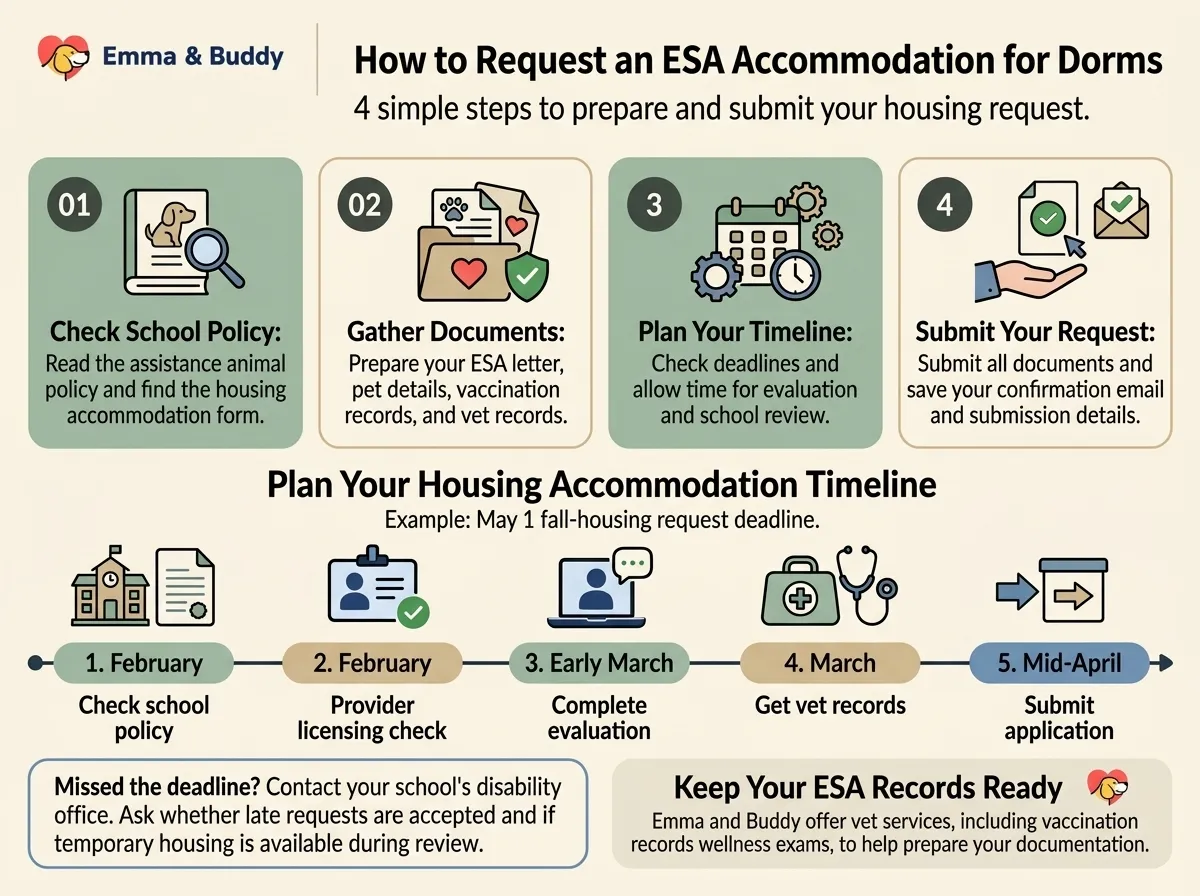
Requesting an ESA Letter for Dorms follows the same college emotional support animal request process at most schools.
-
Read the school’s assistance animal policy.
-
Find the housing accommodation form and note who reviews requests.
-
Gather the form, ESA letter, pet details (species, breed, age, weight), and vaccination and vet records.
-
Submit everything, then save the confirmation email, staff name, and date.
Emma and Buddy’s vet services can supply current vaccination records and a wellness exam for your ESA Letter for Dorms packet. Their 24/7 vet availability helps when paperwork is due soon.
Build a Housing Deadline Timeline
Find three dates first: housing application opening, accommodation request deadline, and room assignment release. Work backward from the request deadline. Leave time for the licensing check, evaluation, any state waiting period, and school review. Check ESA letter laws by state early, since waiting periods vary.
Illustration: a May 1 request deadline for fall housing means starting the licensing check in February and the evaluation by early March. Schools set their own dates.
| Task | Suggested start | Why it matters |
|---|---|---|
| Read policy | February | Shows rules and reviewer |
| Licensing check | February | Confirms provider eligibility |
| Evaluation | Early March | Covers any waiting period |
| Vet records and exam | March | Vaccines must be current |
| Submit package | Mid-April | Leaves time for fixes |
If the ESA Letter for Dorms deadline has passed, contact the disability office. Ask in writing whether late requests are accepted, and ask about temporary housing during review.
What Colleges Can and Can’t Do With an ESA Letter for Dorms
What a College Can Require
A school can verify that your letter comes from a licensed provider. It can hold you to its vaccination, behavior, cleanliness, and noise rules. Most schools also ask you to sign an animal agreement. An ESA Letter for Dorms doesn’t waive any of these rules.
The school can adjust your room or roommate assignment. It can also remove an animal that disrupts others or damages property. If a dog barks every night, expect a warning first and removal if the problem continues.
What a College Can’t Ask or Charge
Schools can’t demand your diagnosis or medical records. They can’t require a registry listing or certificate, and they can’t treat you differently for needing an animal. Under HUD guidance, pet fees and deposits generally don’t apply to assistance animals. You may still owe for actual damage, so confirm your school’s policy.
Your side of the agreement is simple. You handle waste, noise, and damage. Before move-in, book a routine vet visit and update vaccines. Add ID tags and a microchip, set up a quiet sleeping spot, and line up a backup caretaker for travel or emergencies. Knowing how the evaluation and letter process works helps you schedule these steps in the right order.
Pet insurance can cushion unexpected costs. Compare plans that cover accidents and illness, and check waiting periods and exclusions. Read the pre-existing condition rules before you enroll. Emma and Buddy brings your ESA Letter for Dorms, vet access, and insurance together on one platform.
How Does the Evaluation for an ESA Letter for Dorms Work?
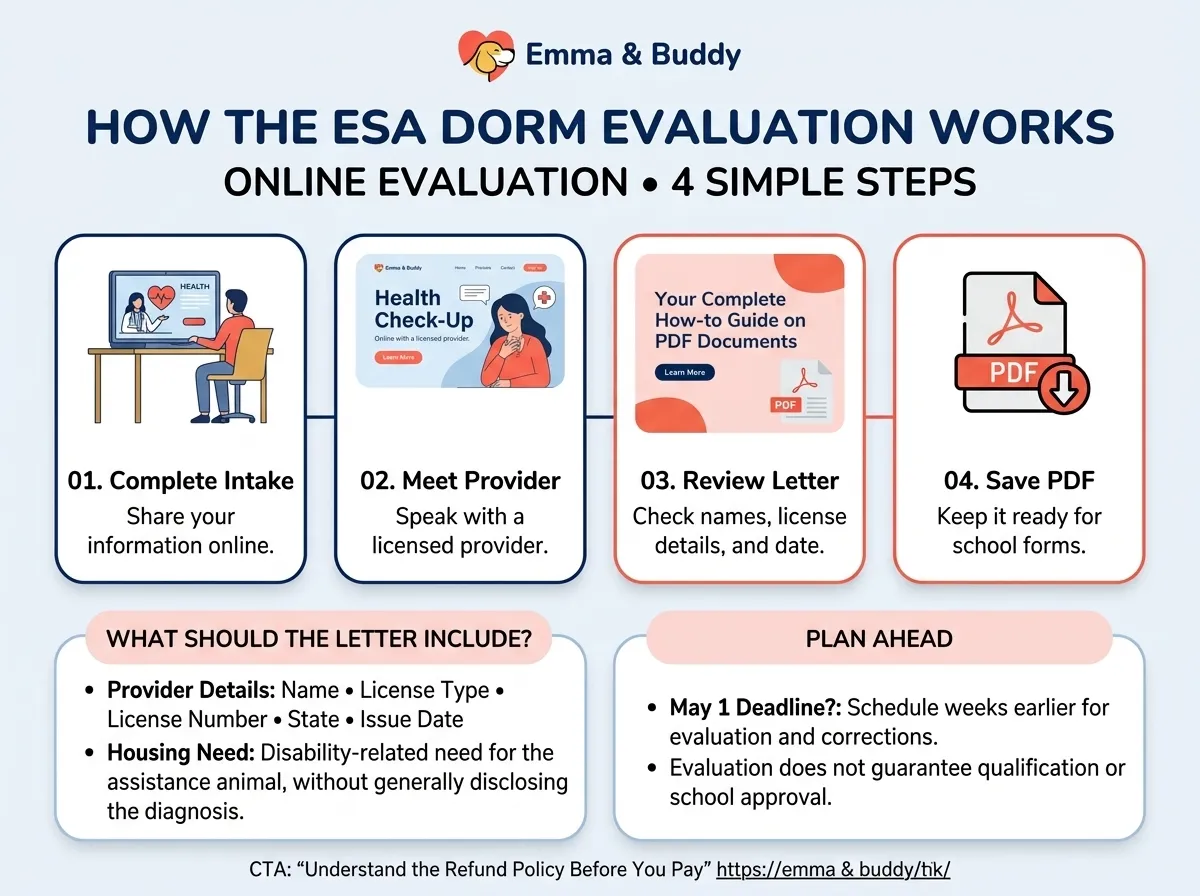
Emma and Buddy runs the evaluation for an ESA Letter for Dorms online. You complete an intake, then talk with a licensed provider. The provider issues a letter only if you qualify. Approval isn’t promised.
-
Complete the intake.
-
Meet with the provider.
-
Review the letter for accuracy.
-
Save a PDF copy and keep it ready for the school form.
A school-ready letter usually lists the provider’s name, license type, license number, issuing state, and date. It states that you have a condition recognized as a disability and need the animal. You generally don’t have to disclose your diagnosis.
Timing matters. Your evaluation date feeds into the housing timeline, so book before the school’s deadline window tightens. A letter that arrives after the cutoff can’t help your request. Since approval isn’t promised, it helps to know how the money-back guarantee policy works before you pay.
For example, a student aiming for a May 1 deadline should schedule the visit weeks ahead. That leaves time to fix any errors in the letter.
Licensed Therapist Requirements For ESA Letter for Dorms
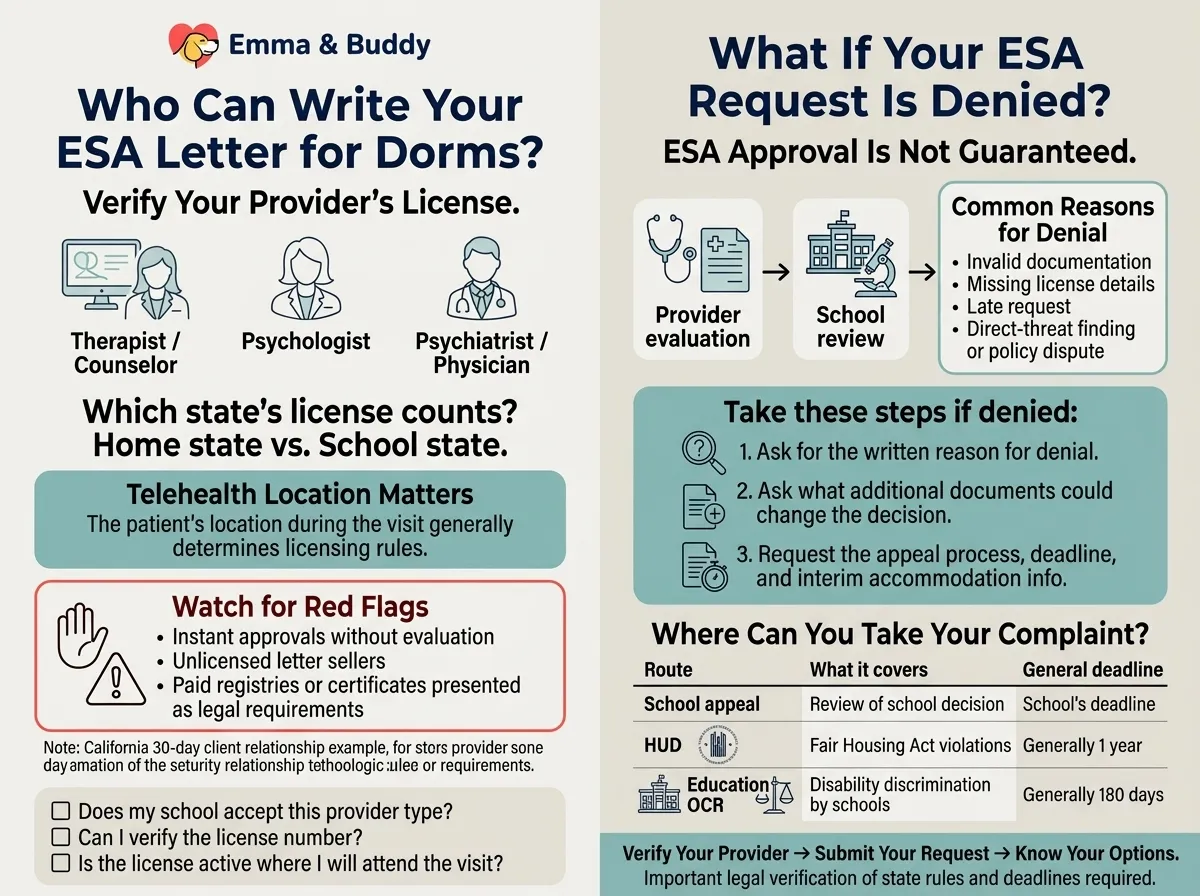
A licensed mental health professional or other licensed healthcare provider can write the letter. That includes a therapist, counselor, clinical social worker, psychologist, psychiatrist, or physician. The provider must be qualified to assess your condition.
Which State’s License Counts?
Few pages explain which license an ESA Letter for Dorms needs. Must the provider hold a license in your home state, your school’s state, or both? No single national answer exists, so ask the school’s disability office and the state licensing board before you pay.
Telehealth adds confusion. Providers generally follow the rules of the state where the patient sits during the visit. That may differ from where you live in summer.
Some states add their own rules. California, for example, requires an established client relationship of at least 30 days before a provider issues an ESA letter. Check whether your home state or school state has a similar rule, and don’t assume other states match. ESA letter state licensing requirements vary.
Watch for red flags: instant-approval pages, sellers that skip a real evaluation, and registries or certificates sold as legal requirements. A registry listing has no legal standing for housing. A valid ESA Letter for Dorms follows a real evaluation.
Questions to ask before booking an evaluation
-
Does the school accept letters from this type of licensed provider?
-
Can I look up the license number on the state board’s website?
-
Is the license active in the state where I’ll be during the visit?
Is Approval Guaranteed for an ESA Letter for Dorms?
No. A provider decides whether you qualify for an ESA Letter for Dorms. The school then decides whether your documentation supports the request. Neither step is automatic, and a letter doesn’t waive pet rules.
Why Requests Get Denied
When an ESA letter is denied by a university, the cause is usually one of these:
-
Documentation from an unlicensed provider or a registry
-
A missing license number or state
-
A late request
-
A direct-threat finding, meaning the school believes the animal risks others’ safety
-
A dispute over school policy
What to Do After a Denial
Ask the school to state the reason in writing. Ask what added documentation would change the decision. Also request the decision-maker’s name and role, the appeal process and its deadline, and any interim accommodation.
Two outside routes exist. You can file a Fair Housing Act complaint with HUD, generally within one year of the alleged discriminatory act. You can also file a disability discrimination complaint with the US Department of Education Office for Civil Rights, generally within 180 days. Check each agency’s site for current filing windows.
| Route | What it covers | Typical time limit | What to bring |
|---|---|---|---|
| School appeal | Review of the school’s decision | Set by the school | Written denial, ESA letter, added documents |
| HUD complaint | Fair Housing Act violations | Generally one year | Timeline, emails, denial notice |
| Office for Civil Rights complaint | Disability discrimination by schools | Generally 180 days | Timeline, denial notice, appeal records |
A clear ESA Letter for Dorms from a licensed provider, sent before the deadline, lowers your risk of denial. This is general information, not legal advice. For complex cases, contact a local disability rights organization or a student legal service.
Conclusion
An ESA Letter for Dorms works best when you treat it as a timing problem, not a game of chance. Schools must review a request backed by reliable documentation, but they don’t have to approve every one. Your letter earns you a review, not a guaranteed yes, and it doesn’t waive pet rules.
The calendar is the part you control. Housing deadlines, state licensing checks, and school review can take days or weeks. Read your school’s policy, check that your provider holds a license in your state, and submit a complete package before the request deadline. Save every email, form, and staff name along the way.
If the school says no, ask for the reason in writing. Then ask what added documentation would change the decision. Appeal and complaint routes stay open to you.
Don’t let a missed deadline make this decision for you. Start your ESA evaluation with Emma and Buddy today, so your ESA Letter for Dorms is ready well before housing requests close. Then book a vet visit and explore pet insurance for your animal, so you both arrive on campus prepared.





 Ask ChatGPT
 Ask Claude
 Ask Perplexity