
Fair Housing Act ESA Letter: Know Your Renting Rights
Nearly 30% of rental applications with emotional support animals face pushback from landlords. A Fair Housing Act ESA letter is proof from a licensed healthcare provider. It confirms your need for an emotional support animal. The letter also gives you federal protection. Landlords usually must grant reasonable accommodations when the letter is valid. Many renters don’t know that landlords can’t charge pet fees or deposits for ESAs. Landlords also can’t demand specific training. Most conflicts happen when landlords don’t understand HUD rules.
This guide explains your federal housing rights under the Fair Housing Act. You’ll learn what makes an ESA letter valid. You’ll also learn what landlords can ask for. You’ll see how to respond if your landlord stalls or denies your request. You’ll also get clear steps for documenting and submitting your request.
Fair Housing Act ESA Letter: What It Is and Why It Matters
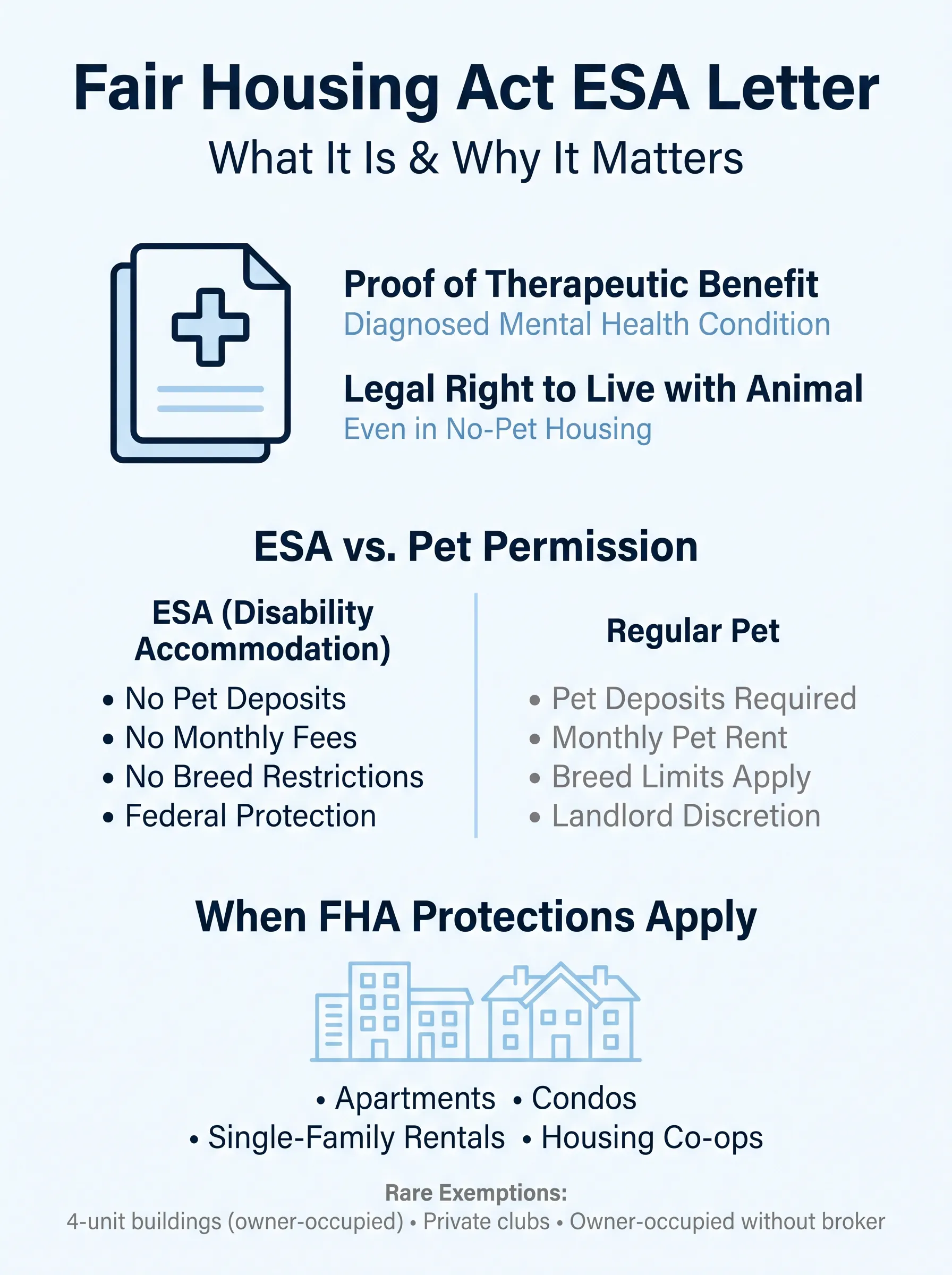
This isn’t a permission slip for a pet. An ESA letter for housing is proof that your animal provides therapeutic benefit for a diagnosed mental health condition.
The letter establishes your legal right to live with your animal even in housing with no-pet policies.
How ESA Letters Differ from Pet Permission Forms
The Fair Housing Act classifies ESAs as disability accommodations, not pets subject to standard pet policies. This means landlords cannot charge pet deposits, monthly pet fees, or breed-specific restrictions that would apply to regular pets.
Your ESA letter exempts you from these costs and rules entirely. Check which types of animals qualify, since the rules vary. Protection stays the same once you have valid documentation.
Federal Protection Under the Fair Housing Act
Federal law treats your ESA letter for housing as a disability accommodation request under civil rights protections. Landlords must approve reasonable accommodation requests unless they can prove undue financial burden. They can also deny it if your specific animal poses a direct threat based on an individualized assessment.
They cannot deny you based on breed, size, or general pet policies. Checking your state’s ESA housing laws helps you know your full range of rights.

When Fair Housing Act Protections Apply to Your Rental
Protection covers apartments, condos, single-family rentals, and housing co-ops, with few exceptions. Most rental properties must honor an ESA letter for housing, regardless of their standard pet policies.
Buildings with four or fewer units where the owner occupies one unit may be exempt from FHA requirements. Owner-occupied properties without a broker and private clubs that limit membership can also qualify for exemptions. These cases are rare.
What Makes an ESA Letter Valid Under HUD Guidelines
A valid ESA letter must come from a licensed healthcare provider actively treating your mental health condition. This includes therapists, psychologists, psychiatrists, or licensed clinical social workers who have established a therapeutic relationship with you.
The documentation must confirm your disability-related need for the specific animal and explain how it provides therapeutic benefit. Generic letters that don’t connect your need to your condition fail to meet Fair Housing Act standards.
Required Elements in Your ESA Documentation
Your letter must include the provider’s license number, jurisdiction, and contact information for verification purposes. Landlords use this to confirm your provider is licensed and authorized to assess your condition.
Your documentation should state that you have a disability under the Fair Housing Act. It should also say the animal provides disability-related help. Many pet owners who use Emma and Buddy find that knowing how long letters last helps them plan their housing accommodations properly.
HUD’s May 2026 Enforcement Guidance on Fair Housing Act ESA Letters
The National Association of Realtors reports that HUD issued new enforcement guidance on May 22, 2026. Under it, HUD will generally pursue federal complaints only when an animal is individually trained for tasks tied to a disability.
The guidance changes how HUD handles federal complaints. State and local fair housing laws may still protect emotional support animals. Check the rules where you live before you submit a request. A fair housing act ESA letter from a licensed provider who knows your condition still gives your request the strongest support.
Red Flags That Invalidate ESA Letters
Online ESA letter services that offer instant approval without clinical evaluation produce invalid documentation under current HUD standards. These mills prioritize speed over legitimate assessment and create letters that landlords can legally reject.
Letters without license details, generic templates, or notes from unlicensed life coaches all fail Fair Housing Act requirements. Landlords who spot fake letters can deny your request until you provide proper proof.
What Landlords Can Ask For in a Fair Housing Act ESA Letter (and What They Cannot Demand)
Knowing your rights helps when property managers ask for documentation for your emotional support animal. Under HUD guidance, a landlord may ask for reliable documentation that you have a disability and that your animal provides support related to that disability. That request has limits, though. A landlord generally can’t demand your full medical records or ask for the details of your diagnosis. A short letter from your licensed healthcare provider usually covers what the landlord is allowed to ask. If a request goes beyond that, you can ask the landlord to explain the reason in writing.
Permissible Documentation Requests Under the Fair Housing Act
Landlords may ask for proof only if your disability or need isn’t obvious or already known. Property managers can verify that your provider is licensed and that the letter confirms a need for the animal.
They can contact your provider to confirm the letter is real and check license status. This check protects both sides from fake letters.
Questions Landlords Cannot Legally Ask.
Landlords cannot ask about your diagnosis, medical records, treatment history, or the nature of your disability. These questions violate Fair Housing Act protections.
Property managers cannot demand vet records, training certificates, or breed paperwork. Asking for your animal’s behavior history based only on breed is discrimination.

Looking for a legitimate ESA letter? Make sure it comes from a licensed provider and meets all federal requirements without unnecessary medical details.
The Myth of HUD-Required Language
No federal law requires ESA letters to contain specific HUD-mandated language or phrases. This is a common misconception that confuses many renters.
HUD’s assistance animal guidance says property managers cannot demand you use their preferred letter template. They can’t require specific wording as long as documentation meets Fair Housing Act standards. Your letter needs provider credentials, proof of your disability-related need, and an explanation of the therapeutic benefit. No magic phrases exist.
Landlords who insist on set wording or reject a valid Fair Housing Act ESA letter over formatting may be breaking federal housing law.
How to Submit Your ESA Letter to Your Landlord
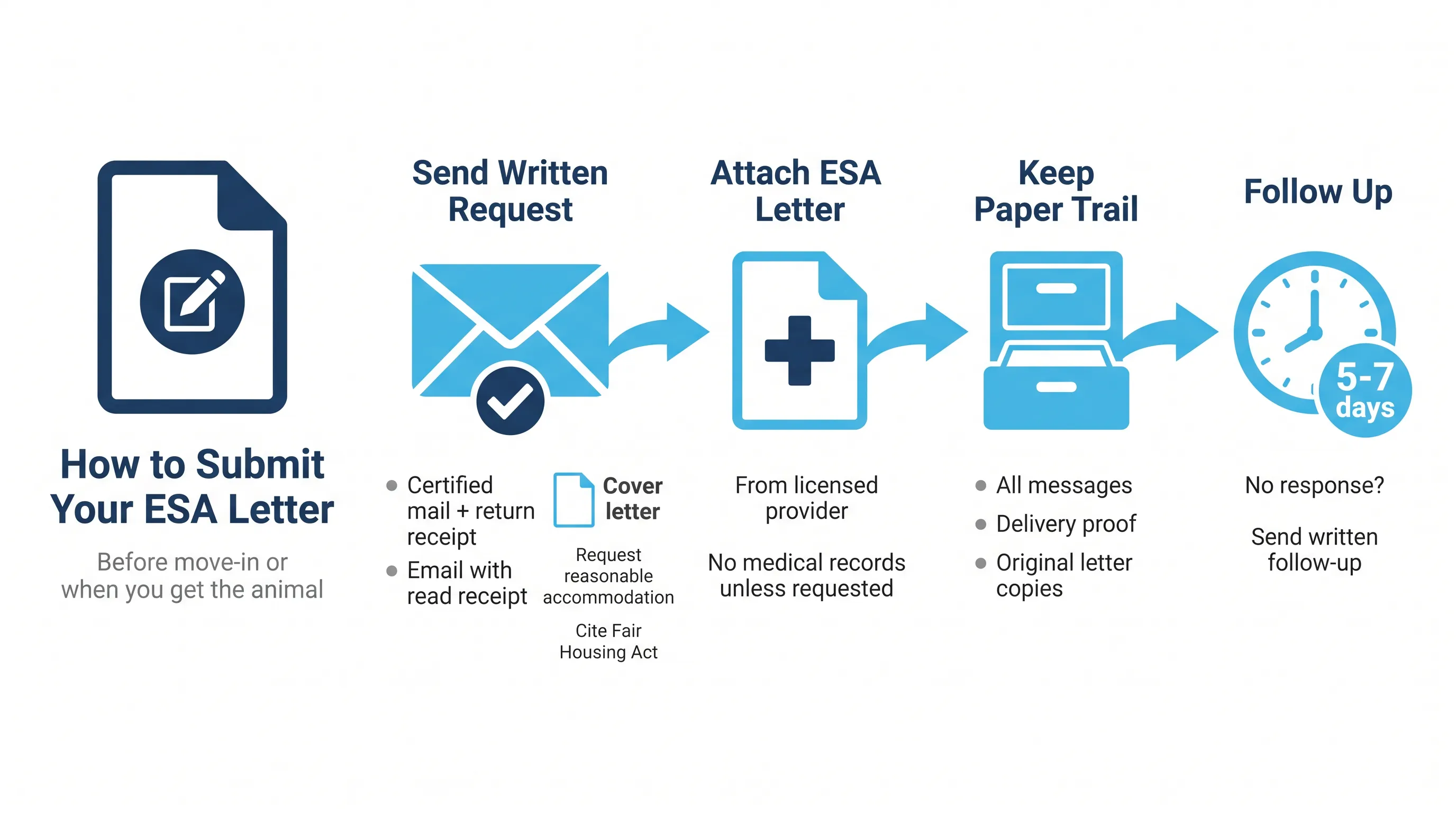
Send your written accommodation request with your ESA letter before moving in, or as soon as you get the animal. Early submission sets your rights from the start of your tenancy. Keep a dated copy of the request and proof that the landlord received it. Those records make it easier to show when you asked.
Best Practices for Written Requests
Use certified mail with a return receipt, or email with a read receipt. Either method proves when your landlord received your request.
Include a short cover letter. Say you are asking for a reasonable accommodation under the Fair Housing Act for your emotional support animal. Keep the language simple and direct.
What to Attach
Attach your ESA letter from your licensed provider. Don’t add medical records unless the landlord asks. Your landlord isn’t entitled to health details beyond the letter.
Keep a Paper Trail
Keep copies of all messages, delivery proof, and your original ESA letter. These records protect you if a dispute comes up later.
If you get no acknowledgment within 5 to 7 business days, follow up in writing. Written follow-ups keep your record complete.
What to Do If Your Fair Housing Act ESA Letter Gets Stalled or Rejected
How Long Landlords Have to Respond
No federal law sets a deadline for landlords to reply to requests. A fair wait is usually 10 to 14 business days. If you hear nothing in two weeks, follow up in writing and note the date.
Long silence with no explanation can suggest discrimination. Keep a record of every follow-up.
Valid Reasons to Deny a Request
Landlords can deny requests only in narrow cases, according to the ADA National Network. Valid reasons include undue financial or administrative burden. They also include a fundamental change to how the property operates. A documented direct threat from your specific animal is another valid reason.
A fake or invalid ESA letter can justify a denial until you provide a proper one. Denials based only on breed violate the Fair Housing Act.
How to Challenge an Improper Rejection
If you are denied, the landlord must give a written explanation with specific reasons. The Disability Rights Education and Defense Fund (DREDF) shares guidance on tenant protections after an improper denial.
You can file a complaint with HUD within one year of the discrimination. You can also ask a local fair housing group for help. Write down every conversation with your landlord. Note the date, the method, and what was said.
If your landlord says no, stay calm and keep it in writing. Most disputes end once the landlord sees a valid Fair Housing Act ESA letter and a clear request.
Conclusion: Your Fair Housing Act ESA Letter Rights
Your Fair Housing Act ESA letter protects your right to live with an emotional support animal, but only if it’s valid. You also need to know the legal rules for accommodation requests. A proper Fair Housing Act ESA letter from a licensed provider is the basis of your housing rights. The provider must have a real treatment relationship with you. Instant online certificates and generic templates don’t count.
When you’re ready, send your letter in writing with proof of delivery. Keep records of every message with your landlord. If you face delays or denials, reply in writing. Cite the Fair Housing Act rules that protect you. You can file a HUD complaint if discrimination occurs. Strong paperwork from the start often prevents conflicts.
Need a legitimate ESA letter? Emma and Buddy connect you with licensed mental health professionals. Each provider assesses your condition before writing your Fair Housing Act ESA letter.





 Ask ChatGPT
 Ask Claude
 Ask Perplexity