
ESA Letter for College Housing
An ESA letter for college housing is a document from a licensed clinician that supports your request to live with an emotional support animal. It doesn’t guarantee approval, and it works differently in a dorm than in an off-campus apartment. Housing deadlines arrive fast, online advice often conflicts, and some websites sell instant certificates that schools may reject.
Dorm rules, rental rules, service animal rules, and air travel rules are not the same. Airlines, for example, no longer have to treat emotional support animals as service animals. This guide helps you work out which rules apply to you and how to request an accommodation step by step. It also covers what your school can and can’t do, and how an online ESA evaluation and its cost work before you pay.
What Is an ESA Letter for College Housing?
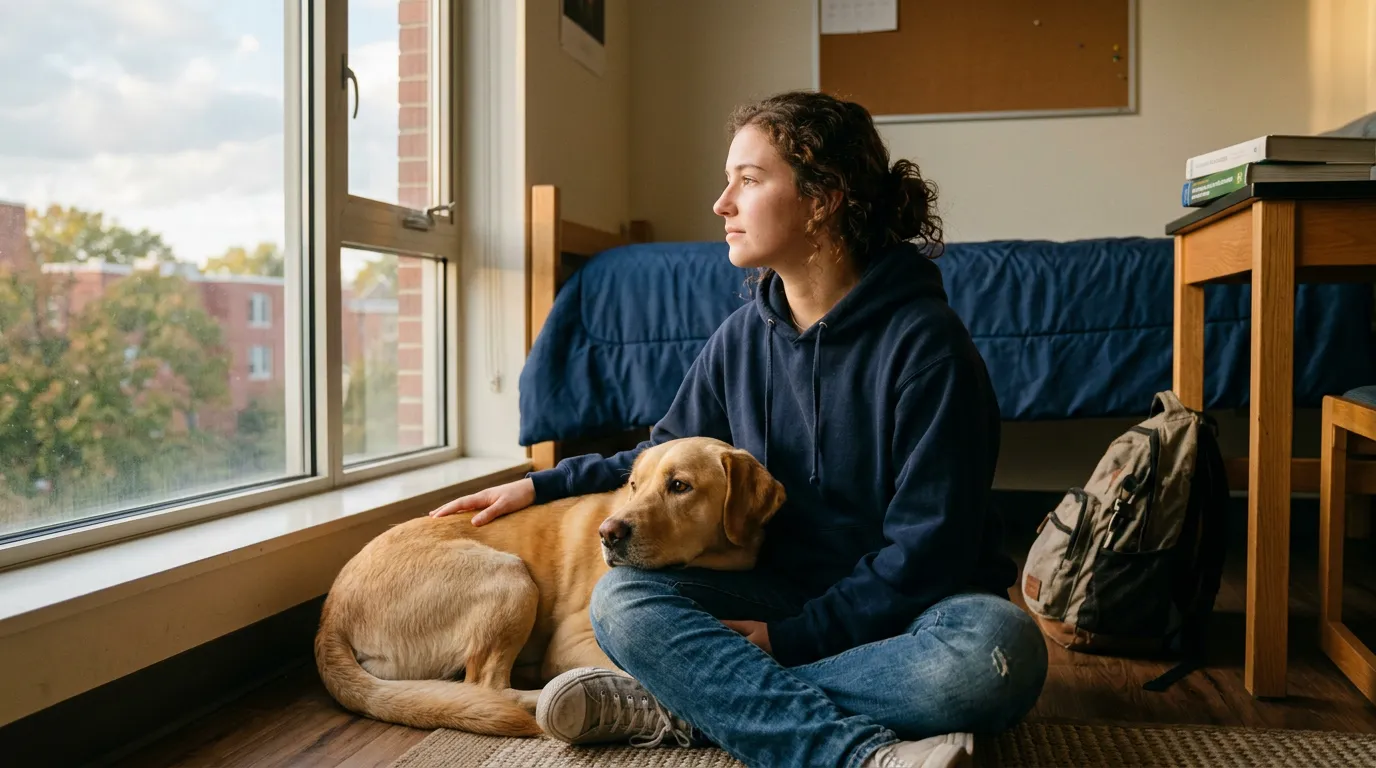
An ESA letter for college housing is a document from a licensed mental health clinician. It states that a student has a disability-related need for an emotional support animal. Students use it to request a reasonable accommodation, such as keeping an animal in a dorm.
The letter is not a registry certificate, an ID card, or a vest. No federal registry exists, so a purchased certificate alone carries no legal weight.
Service animals are dogs trained to perform specific tasks, and they have public-access rights. Emotional support animals help through their presence. The law covers them mainly in housing. Air travel no longer treats ESAs as service animals.
Who Qualifies and Who Can Write the Letter?
You may qualify if you have a mental health condition or disability that limits a major life activity. The condition also needs a documented link to the animal. Common campus examples are anxiety, depression, PTSD, and homesickness-related distress that meets clinical criteria. For instance, a student with nighttime panic attacks might sleep better with a calm cat nearby.
A valid ESA letter for college housing comes from a licensed clinician, such as an LPC, LCSW, psychologist, or psychiatrist. The clinician must hold a license in your state and must have actually evaluated you. Letters from someone who never assessed you often get denied, which can delay your housing plans.
Many students read about an ESA letter for college students before they contact a clinician. That helps them know what to expect from the evaluation.
As for animals, dogs and cats are the most common. A school may review other species case by case. Each ESA letter for college housing is judged against the specific animal and the student’s documented need.
ESA Letter for College Housing: Campus Housing vs. Off-Campus Rentals
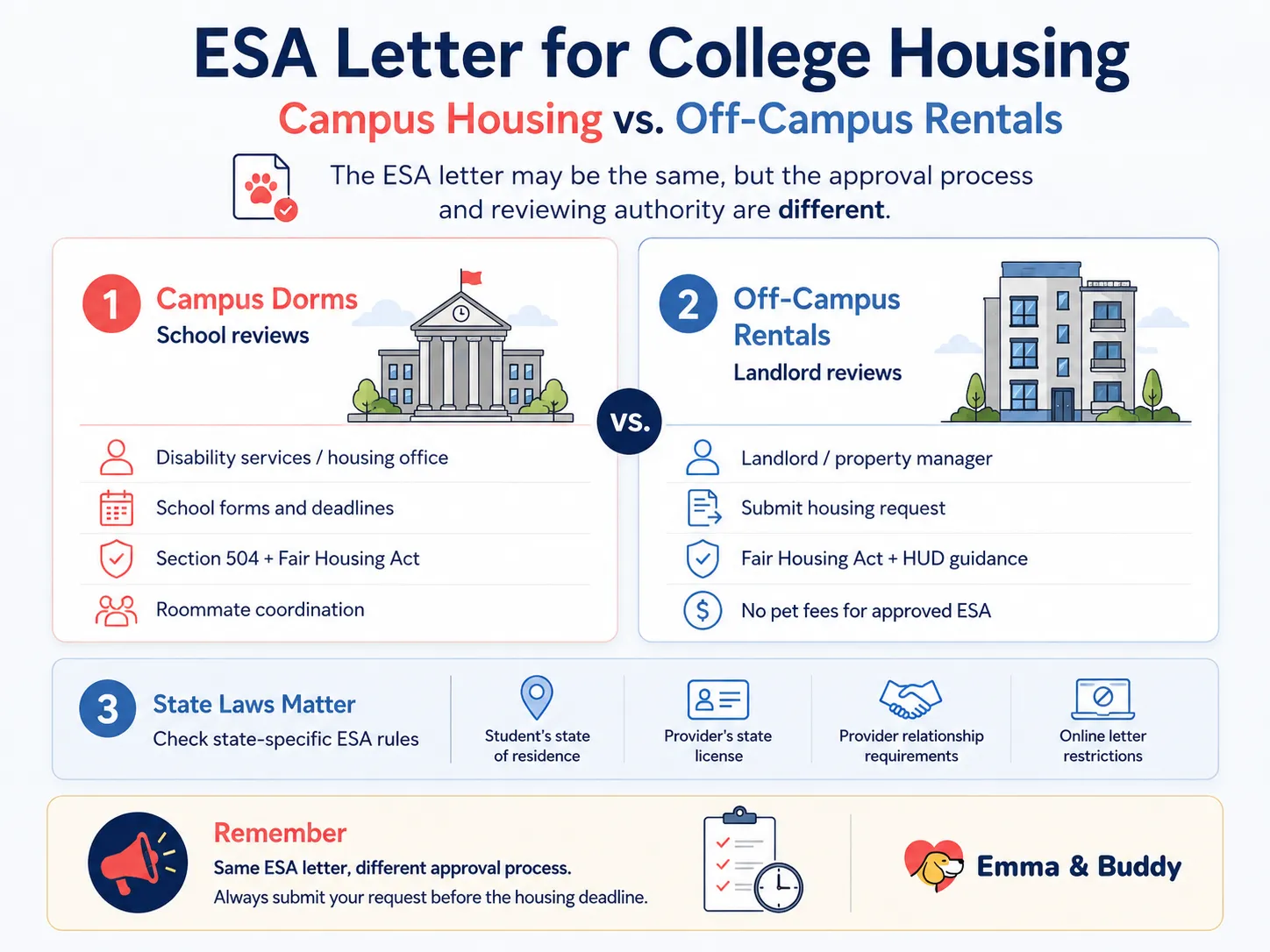
Where you live decides who reviews your request. A dorm request goes through your school, while an apartment request goes to a landlord. The same ESA Letter for College Housing can work in both settings, but the path differs.
How the Fair Housing Act and Section 504 Apply to Dorms?
The Fair Housing Act generally covers dorms. Section 504 of the Rehabilitation Act applies to schools that receive federal funding. Requests usually go through the disability services or housing office, and you must meet school deadlines and use internal forms. An approved ESA isn’t a pet, so campus pet policies don’t apply.
Off-campus, private landlords fall under the Fair Housing Act and HUD guidance (FHEO-2027-01). You send your request to the landlord or property manager, who cannot treat an ESA as a pet. Each landlord handles requests differently, so it helps to learn how an ESA housing letter for rentals works before you apply.
Shared rooms add roommate consent to the mix. Schools often handle roommate notice and room placement, so ask about both before move-in.
What State Laws That Affect Your Letter?
State rules matter most if you study away from home. Michigan’s Persons with Disabilities Civil Rights Act is one example. Many states also limit online ESA letters. Their rules cover how long you must have a relationship with the provider and what the letter must disclose. Some also set penalties for misrepresentation.
Check that your ESA Letter for College Housing meets the rules in the state where you’ll live. Also check the state where your clinician is licensed. Emma and Buddy works with clinicians licensed in your state, which helps you meet these rules.
Hypothetical example: A Michigan student at a state university uses the school’s process for a dorm. The student files the ESA Letter for College Housing with the disability services office before the priority deadline and waits for written approval.
The next year, the student rents an apartment off campus. The school’s form no longer applies, so the student sends a request and a current letter to the landlord instead. The landlord can’t charge pet fees for an approved ESA.
How to Request an Accommodation With an ESA Letter for College Housing
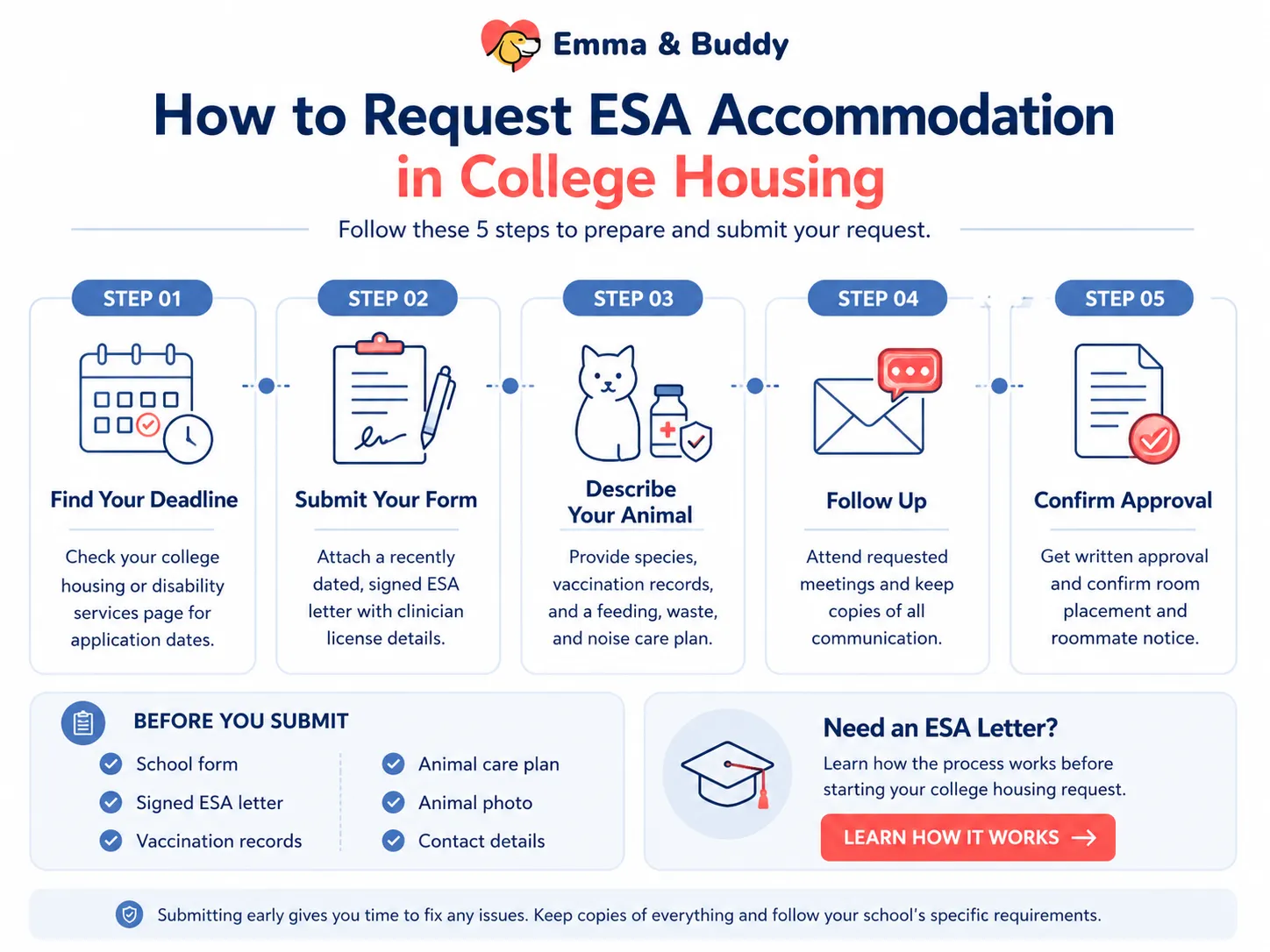
Schools handle requests through a set process, and a missed date can delay your move-in. Each school sets its own forms and dates, so start with its housing page. A complete ESA Letter for College Housing request follows five steps.
Step-by-Step Request Process
-
Find the deadline. Locate your school’s disability services or housing accommodation page and note the deadline. Many schools set priority dates months before move-in.
-
Submit the form. Complete the school’s accommodation form and attach your letter. It should be recently dated and signed, and list the clinician’s license number and state.
-
Describe your animal. Include the species, vaccination records, and a care plan covering feeding, waste, and noise. Schools use this to judge whether the animal fits shared living.
-
Follow up. Attend any interview or follow-up with the accommodation coordinator. Keep copies of every message.
-
Confirm approval. Get the decision in writing. Ask about roommate notice and room placement, and check campus rules for animal care.
Picture a student with a cat who applies in March for a fall room. Ready vaccination records and a litter plan can head off a second round of questions. Written approval also gives you proof if housing staff change. Submitting your ESA Letter for College Housing early leaves time to fix any gaps.
Sample Request Checklist
Gather these items before you submit anything:
-
Completed school accommodation form
-
ESA letter, recently dated and signed, with license number and state
-
Vaccination records for your animal
-
Written care plan for feeding, waste, and noise
-
Photo of your animal and your contact details
-
Copies of all emails and forms
Missing items can stall an ESA Letter for College Housing request, so check your school’s page for extras. If you still need a letter, get proper information and guidance about how the process works before you start.
ESA Letter for College Housing Rules: What a College Can and Cannot Do
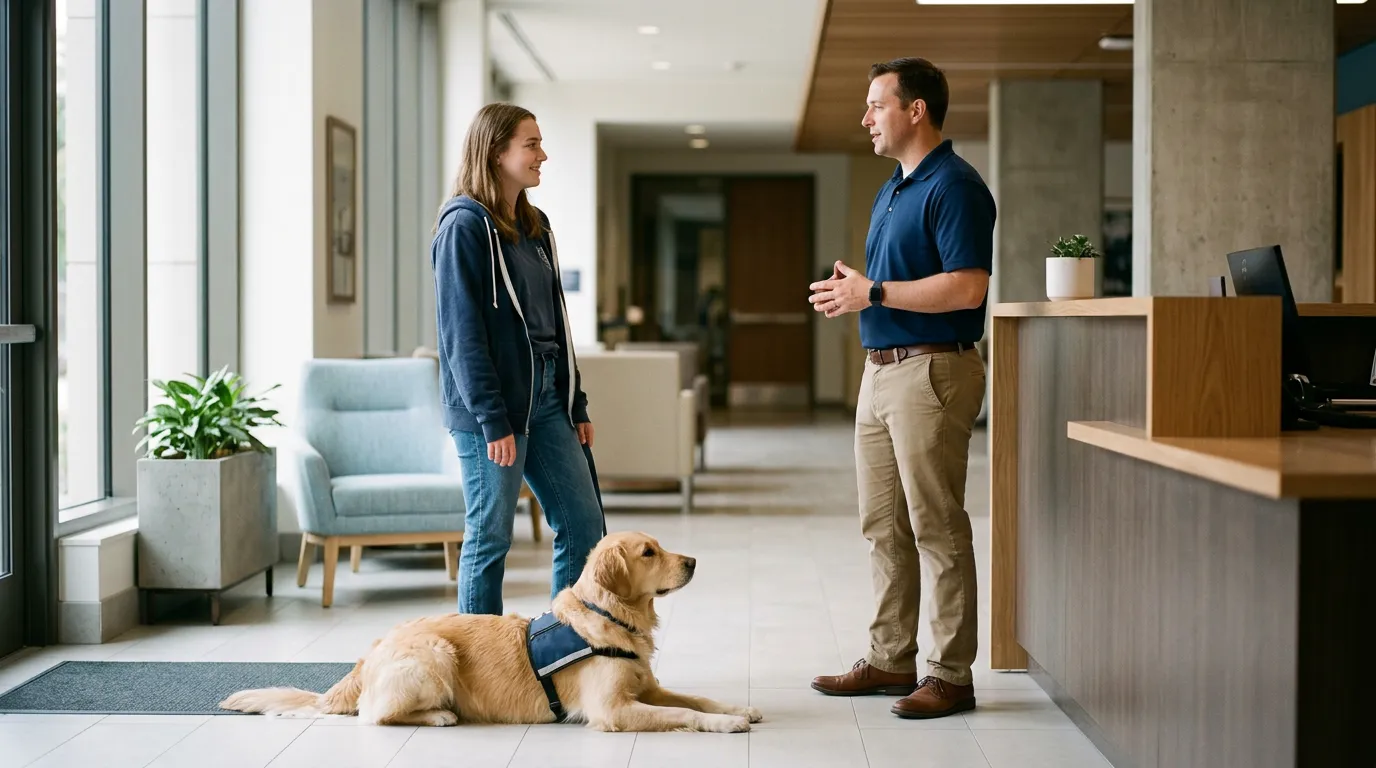
A school has real limits on how it treats an ESA Letter for College Housing. It can set some rules, but it can’t treat your animal like a pet.
| Topic | What a College Can Do | What a College Cannot Do |
|---|---|---|
| Documentation | Ask for reliable documentation when your need isn’t obvious | Demand a diagnosis, medical records, or a registry certificate |
| Fees | Set reasonable conduct and care rules | Charge pet fees or deposits for an approved ESA |
| Animal restrictions | Deny a specific animal that poses a direct threat or causes undue burden | Apply breed or size limits without an individual assessment |
| Timing | Review requests through its set process | Ignore a properly documented request |
A school that asks for your diagnosis usually goes beyond what the law allows. You can decline that part and offer a letter stating your disability-related need. State rules can add details, and ESA letter laws by state differ on provider licensing and online letters.
Common Reasons for Denial and How to Appeal
Most denials of an ESA Letter for College Housing trace back to fixable problems:
-
Late or incomplete paperwork
-
A letter from a clinician who never really evaluated you
-
A letter that doesn’t state a disability-related need
-
A specific animal’s behavior history, such as past aggression
If you get a denial, follow these steps:
-
Ask for the denial in writing, with the reasons.
-
Submit stronger documentation, such as a new letter from a clinician who has evaluated you.
-
Use the school’s internal appeal process.
-
Contact HUD or the Michigan Department of Civil Rights (or your state’s agency) if the school doesn’t resolve it.
Say a student is denied because the letter never named a need. That student can request a revised letter and resubmit it. Clear paperwork makes any appeal easier.
How Does the Evaluation Work for an ESA Letter for College Housing?
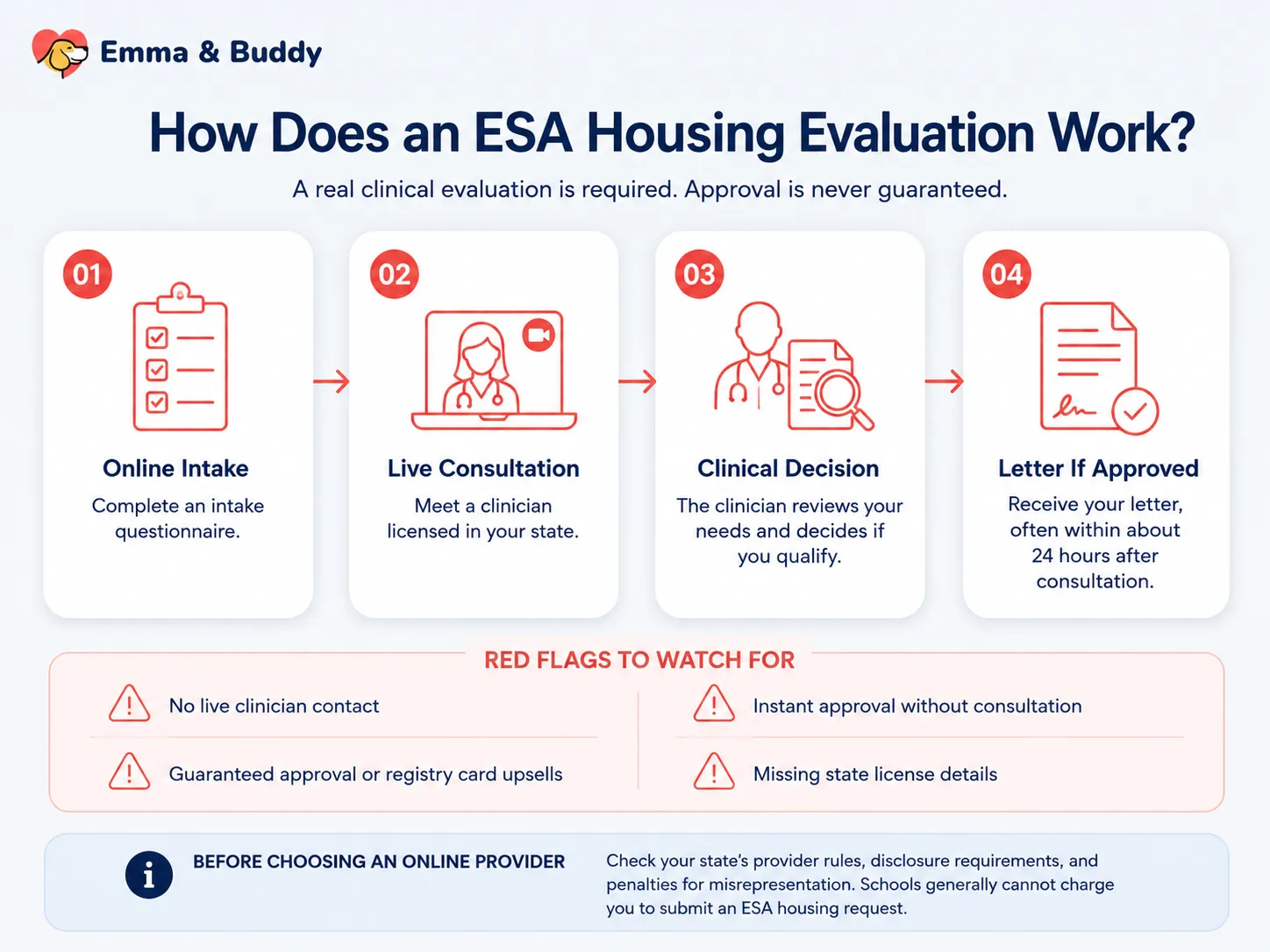
A legitimate evaluation is a real clinical visit, not a form you pay for and download. Knowing the steps helps you spot a valid ESA Letter for College Housing.
Legitimate evaluations usually cost a modest fee for a real clinician visit. Letter mills sell instant certificates with no live consultation. Compare any price with a campus counselor visit. Schools generally cannot charge you to submit a request.
Watch for these red flags:
-
No live contact with a clinician
-
Instant approval promised
-
Registry or ID card upsells
-
No state license information
State rules matter too. Before you buy online, check how long the provider must know you, what disclosures they owe you, and the penalties for misrepresentation.
Telehealth Evaluation Steps
-
Complete an online intake questionnaire.
-
Hold a live consultation with a clinician licensed in your state.
-
Receive the clinician’s decision on whether you qualify.
-
Get your letter if approved, often within about 24 hours after the consultation.
The clinician looks at your symptoms, how they affect daily life and your studies, and how the animal helps. Dogs and cats are common, get information about which animals qualify for an ESA letter before your visit. Approval is never guaranteed.
Conclusion
An ESA letter for college housing is a request, not a guarantee. It gives your school a licensed clinician’s support for your disability-related need, and the school decides whether to approve the accommodation. Rules differ between campus housing and off-campus rentals, so match your request to where you’ll live.
Know what your school can and can’t do. Colleges can ask for reliable documentation. They can’t charge pet fees or demand your full medical records. A purchased certificate or registry ID carries no weight, but a real evaluation with a licensed clinician does. Timing matters too. Late or incomplete paperwork is a common reason for denial, and you can avoid it.
Follow three steps in order. Start with your school’s deadline, since many priority dates fall months before move-in. Next, confirm your state’s rules, especially if you study away from home. Then get evaluated so your ESA letter for college housing is signed, current, and ready before you submit your form.
Don’t let a missed deadline keep you apart from your animal. Book your evaluation with Emma and Buddy today and take the next step toward bringing your companion to campus.





 Ask ChatGPT
 Ask Claude
 Ask Perplexity