
ESA Letter Requirements
ESA Letter Requirements decide whether your landlord says yes or asks for more proof. The rules shift based on who wrote the letter, what it says, and which state you live in. Under HUD notice FHEO-2027-01, a landlord can ask for reliable documentation when your disability isn’t obvious. In practice, that means a letter from a professional who knows your situation firsthand.
Most guides cover one state or stay general. Few explain what that standard means day to day, how to spot a letter mill, or what a real evaluation costs. Renters end up guessing, and a rejected letter can cost them a lease or their pet. This guide shows what the Fair Housing Act requires and what a valid letter must include. You’ll also learn how a licensed therapist evaluation works, why landlords deny letters, and what to do after a denial.
What Are ESA Letter Requirements?

ESA Letter Requirements are the rules that make an emotional support animal letter valid for a landlord. In most cases, a licensed mental health professional must write it after evaluating you. The letter confirms that you have a disability-related need for the animal.
ESA vs service dog vs therapy animal: legal differences
Each animal type gets different legal treatment, so the label matters. An emotional support animal gives comfort through its presence and needs no special training. Its main protection comes from the Fair Housing Act, which can let you keep the animal in a building with a no-pet policy.
A service dog is trained to perform specific tasks for a person with a disability, such as guiding someone who is blind. The Americans with Disabilities Act lets service dogs enter most public places, including restaurants and stores. An ESA doesn’t get that access. Airlines also no longer treat ESAs as service animals, so they usually fly as regular pets.
A therapy animal visits hospitals, schools or nursing homes to comfort groups of people. Its handler is usually a volunteer. A therapy dog in a library reading program is welcome by invitation, but it has no housing or public access rights.
Federal law sets the baseline for ESA Letter Requirements, though some states add their own rules. Before you rent, review ESA letter laws by state to spot local differences.
Knowing these differences also protects you from scams. A site that sells an ESA “registration” or an instant certificate isn’t giving you a legitimate ESA housing letter. Landlords look for ESA Letter Requirements, not badges, ID cards or online registry numbers.
ESA Letter Requirements: What a Valid Letter Must Include
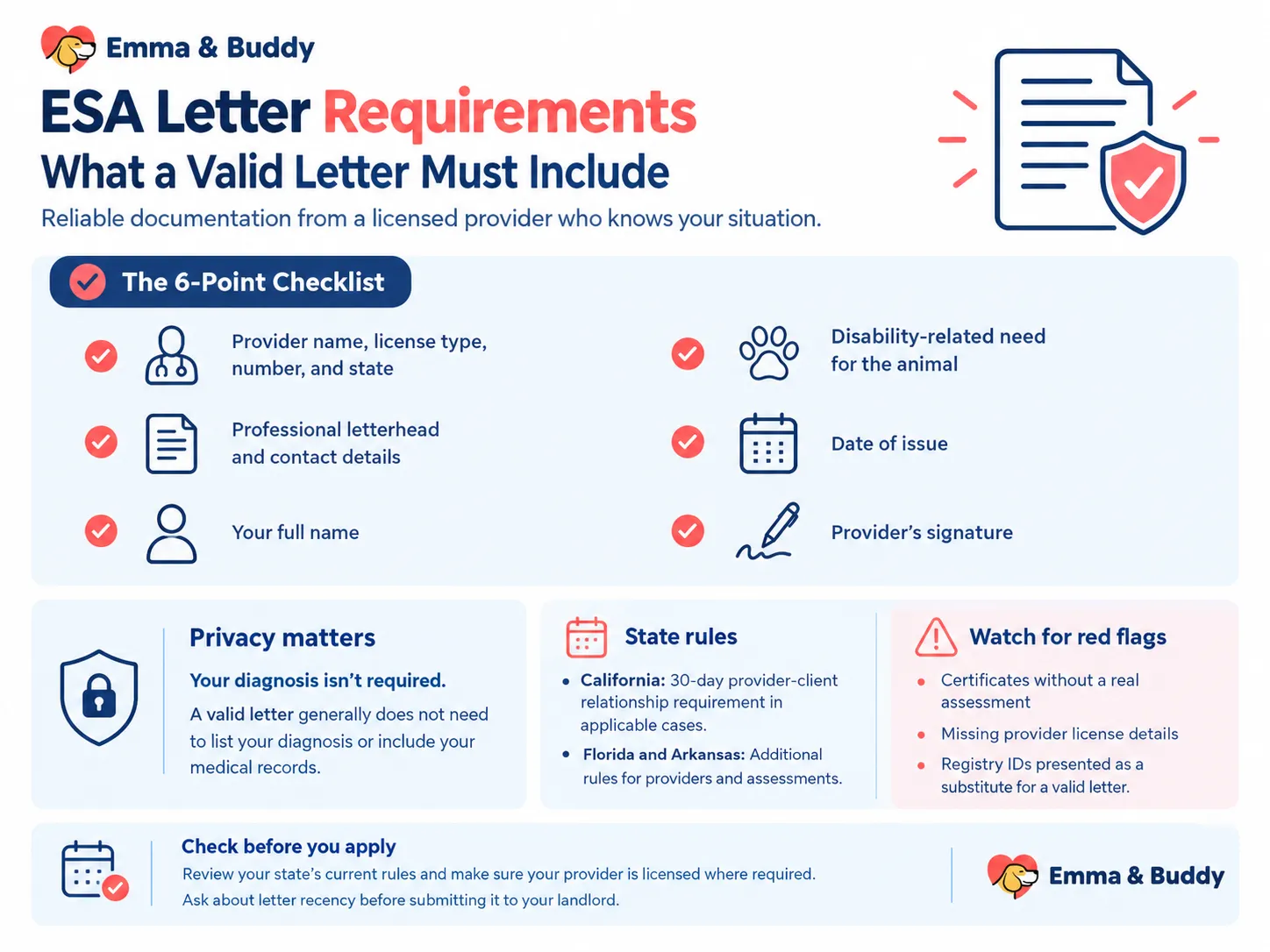
A landlord wants proof that a real provider assessed you. ESA Letter Requirements are met when the letter shows that proof clearly. HUD calls this reliable documentation, and it comes from a licensed professional who knows your situation.
Checklist of required letter elements
A valid letter usually contains these items:
-
The provider’s name, license type, license number and state of licensure
-
Letterhead with the provider’s contact details
-
Your full name
-
A statement that you have a disability and that the animal helps with a disability-related need
-
The date the letter was issued
-
The provider’s signature
Most landlords want a recent letter, so it helps to know how long an ESA letter lasts before you apply. A letter signed 18 months ago may lead a landlord to ask for a new one.
The letter doesn’t need to name your diagnosis. Landlords generally can’t demand medical records or details about your condition. A letter that lists a diagnosis isn’t invalid, but it shares more than ESA Letter Requirements call for.
ESA letter requirements by state
State rules add to the federal baseline, and they differ a lot. California, for example, requires a provider to have a client-provider relationship of at least 30 days before issuing a letter. Florida and Arkansas also regulate how providers assess patients and penalize false claims.
Because laws change, check your state’s current rules before you sign anything. A provider who isn’t licensed in your state can’t write a letter that meets local law. Emma and Buddy matches you with a provider licensed where you live, which helps your letter meet state standards.
Some online sellers skip these steps and hand out a certificate or registry ID instead. A landlord can reject those documents, since they lack a provider’s license details and a real assessment. Compare any letter against the checklist above, and treat missing items as a warning sign. Solid ESA Letter Requirements protect you as much as they protect the landlord.
ESA Letter Requirements and the Licensed Therapist Evaluation

A valid letter starts with a real evaluation. The provider asks about your symptoms, history and daily routine. Then they decide whether an animal helps with a condition you have. This step sits at the center of ESA Letter Requirements, because a landlord can’t trust a letter written without an assessment.
Only a licensed professional can make that call. Therapists, counselors, psychologists, social workers and psychiatrists often qualify when their license is active. According to the Ohio CSWMFT Board, licensed clinicians must follow ethical and clinical standards when they evaluate patients and sign emotional support animal letters. A provider who skips the evaluation risks discipline.
Picture a renter with panic attacks who tells the provider how their dog calms their evenings. The provider records that link and the symptoms it eases. That record supports the letter if a landlord ever asks questions.
Telehealth evaluations and licensing
Telehealth evaluations are generally accepted, since a video visit is still a real clinical session. They help people in rural areas or with limited mobility. Still, the provider must hold a license in your state. A therapist licensed only elsewhere usually can’t legally evaluate you, so ESA Letter Requirements depend on where you live.
Verify the license before you book. Most state boards offer a free online lookup where you can search a name or license number. Watch for warning signs, such as instant approval, no live conversation or a provider who won’t share a license number.
Ask what happens after the visit. A good provider explains how the letter is issued, whether follow-up is needed and what you’ll pay. Fees vary, so compare them, and be wary of prices that seem too low for a real clinical visit.
Emma and Buddy connects you with licensed professionals who evaluate you by video. That way you can complete your evaluation from home with a provider licensed in your state.
ESA Letter Requirements Landlords Reject
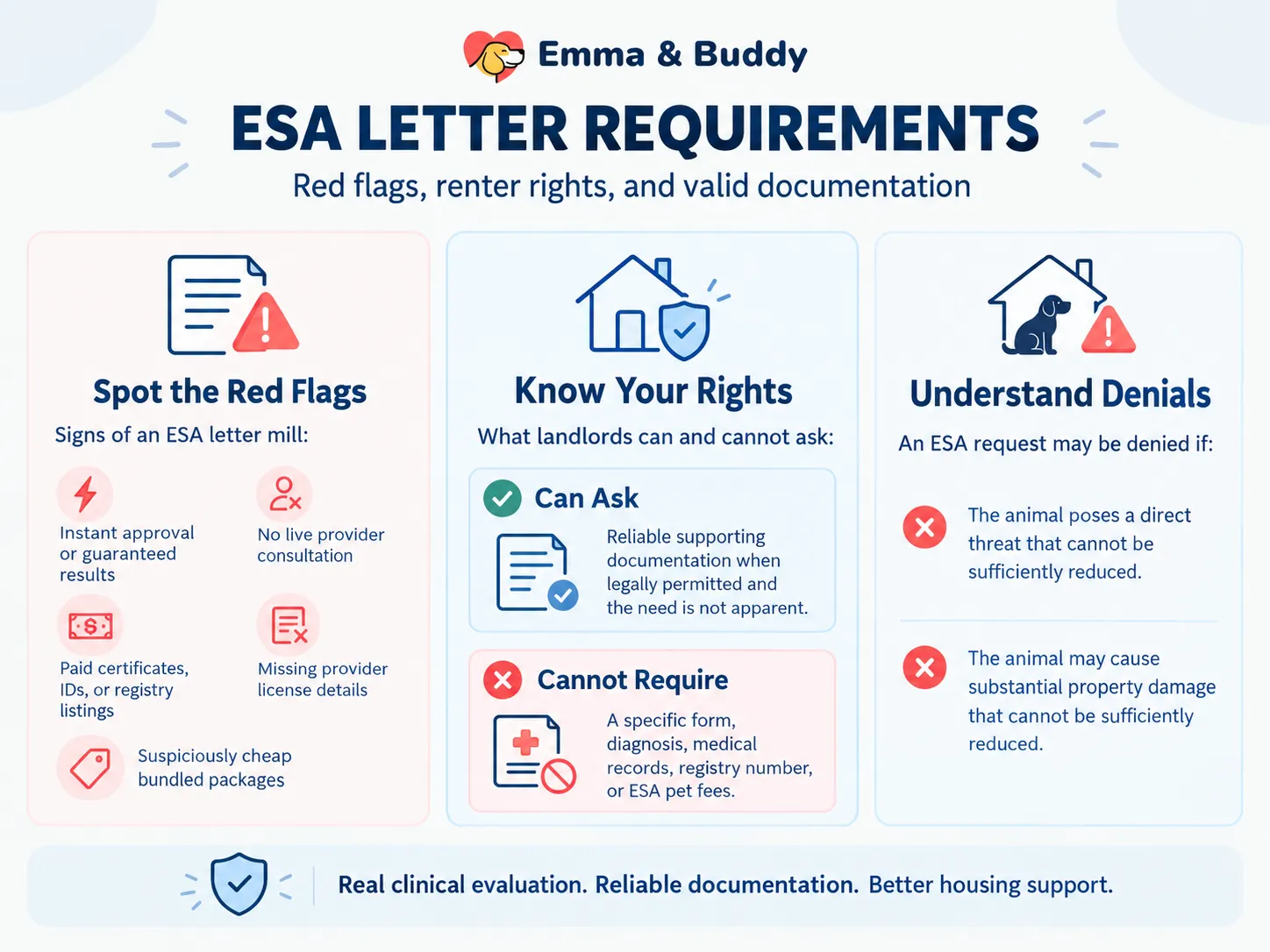
Landlords often reject letters that fail basic ESA Letter Requirements, and the reasons are usually easy to spot. Most rejections trace back to a seller that skipped a real clinical visit.
Warning signs of an ESA letter mill
Letter mills sell speed instead of care. Watch for these red flags:
-
Instant approval, or a “guaranteed” result before any evaluation
-
No live contact with a provider, only an online quiz
-
Certificates, ID cards or registry listings sold as proof
-
No license number or state of licensure on the letter
-
An ESA letter cost so low that it comes bundled with vests and tags
A landlord who sees these signs can reasonably doubt the letter. A renter who buys a cheap registration package may get turned away, because the paperwork proves nothing about a real assessment. These ESA letter scams and red flags also waste time when you need housing quickly.
What a landlord can and cannot ask
Under the Fair Housing Act, a landlord may ask for reliable documentation when your disability or need for the animal isn’t obvious. HUD guidance says they can’t demand your diagnosis, your medical records or a specific form. They also can’t require a registry number or charge a pet deposit or pet fee for an ESA.
Landlords do keep some room to say no. They can reject a particular animal that poses a direct threat or would cause damage that can’t be reduced. Many disputes come down to when a landlord can deny an ESA request, and the answer depends on the animal and the paperwork.
Clear ESA Letter Requirements protect both sides. You keep your home, and the landlord gets proof that a real provider reviewed your case.
Meeting ESA Letter Requirements Through a Legitimate Evaluation
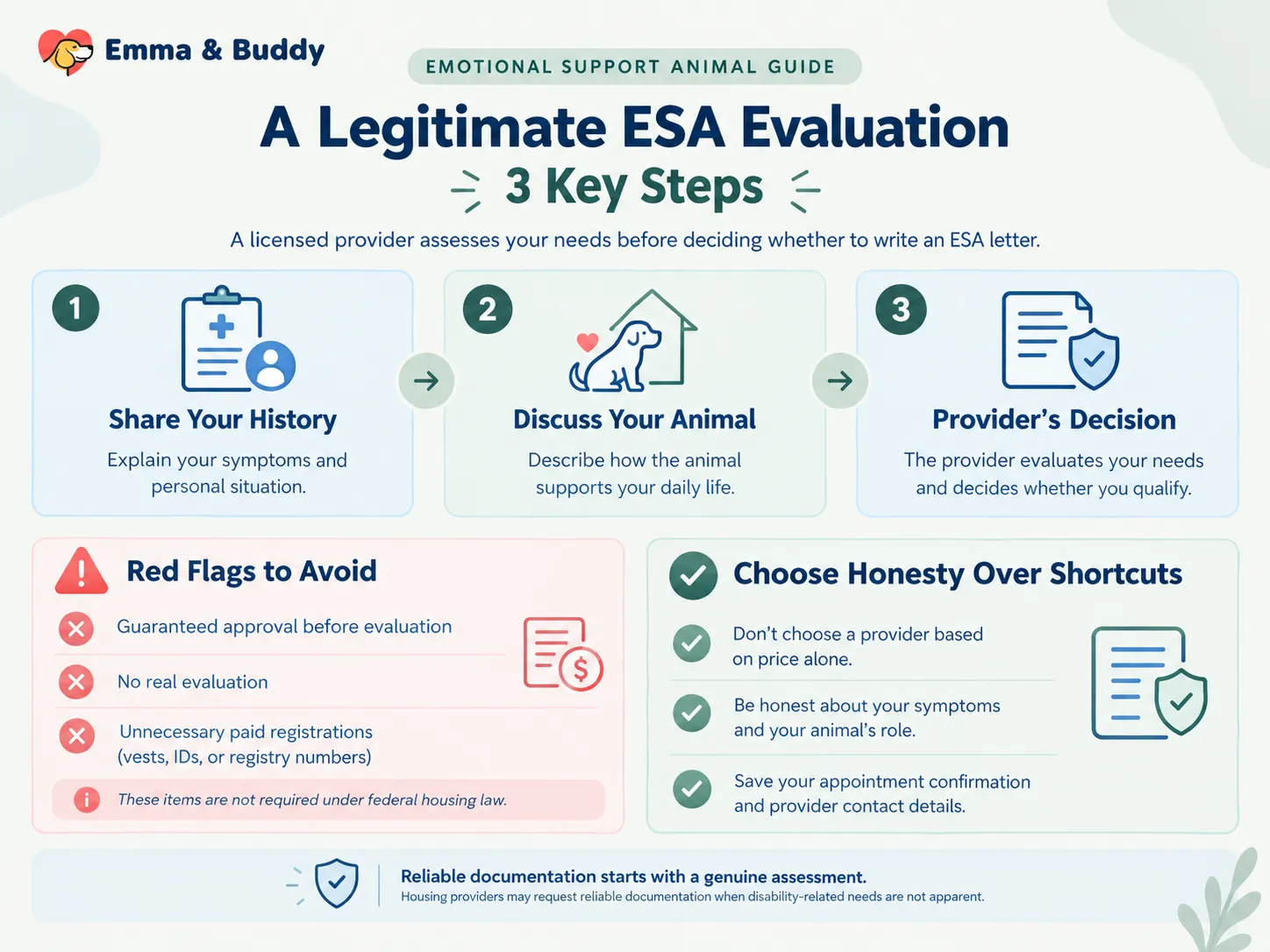
ESA Letter Requirements come down to one idea: a licensed provider must truly assess you. A legitimate evaluation usually has three parts. You share your history and symptoms, the provider asks how the animal helps, and then they decide whether you qualify. A renter whose cat eases anxiety, for example, would explain how the cat fits into daily routines.
Landlords want reliable documentation, not a pile of fees. According to the American Bar Association, HUD guidance lets housing providers request reliable documentation. That applies when the disability or the need for the animal isn’t obvious. A provider who evaluated you can supply it.
ESA letter cost varies by provider, but price shouldn’t drive your choice. A very low fee with same-day delivery often signals a shortcut. Real evaluations take some time because the provider reviews your answers.
ESA letter scams and red flags are easy to spot once you know them. Be wary of sites that promise approval before you speak with anyone. Also avoid sellers pushing registry numbers, vests or ID cards. Federal housing law doesn’t require any of those, and fake sellers often ignore ESA Letter Requirements entirely. A legitimate provider can decline to write a letter if you don’t qualify.
Honesty protects you as well. Meeting ESA Letter Requirements works best when you describe your real situation, since a provider can only document what they actually find. If a landlord questions the letter, a truthful evaluation gives you something solid to stand behind. Save your appointment confirmation and the provider’s contact details in case a landlord wants to check.
Conclusion
A valid letter is simple. A licensed professional who evaluated you signs and dates it, and the letter states your disability-related need for the animal. No registry or certificate can replace that. Check your state’s rules too, since some, like California, expect a 30-day relationship with the provider first.
Landlords reject letters from mill sites that skip the evaluation. If you get a denial, you can send a corrected letter or file a HUD complaint. Airlines no longer have to accept ESAs, so plan travel around each carrier’s pet policy.
The ESA Letter Requirements come down to one idea: a real evaluation by a real licensed provider. The format and state details all support that.
Start your licensed-provider evaluation with Emma and Buddy. Then check your state’s rules against the state table. Once your letter is in hand, explore pet insurance and 24/7 vet services to protect your animal’s health.





 Ask ChatGPT
 Ask Claude
 Ask Perplexity