
Why Instant ESA Letters Get Rejected
You paid for an ESA letter and got a PDF in ten minutes. Your landlord still said no. Why Instant ESA Letters Get Rejected usually comes down to speed. A letter that arrives in minutes often skips a real evaluation by a licensed professional.
HUD guidance, FHEO-2027-01, lets landlords refuse documentation that doesn’t reliably show a disability and a disability-related need. Some states also require an existing provider-client relationship. Many pages skip these details and simply point you to a paid service. This guide explains in plain language what a valid letter looks like. You’ll learn which red flags to spot before you pay. You’ll also learn how to start the process the right way, so your landlord accepts the result.
What an ESA Letter Is and Why Instant ESA Letters Get Rejected

Many renters buy a letter online in minutes, then hear “no” from the landlord. This article explains Why Instant ESA Letters Get Rejected. The problem is the shortcut, not the idea of getting a letter online.
What an ESA letter is and who can write one?
An ESA letter is a signed document from a licensed health professional. It states that you have a disability and that your animal helps with a disability-related need. It ties to the Fair Housing Act, not to pet rules.
Who can write an ESA letter? Licensed psychologists, psychiatrists, clinical social workers, licensed counselors, and other licensed providers who treat you can. A service animal is trained to do specific tasks for a person with a disability. An ESA gives comfort and support and needs no special training.
The three reasons landlords turn letters down
Landlords usually refuse a letter for one of three reasons: no real evaluation, missing license and letter details, or reliance on registries and certificates. A letter with no license number, gives a landlord an easy reason to say no. If you already got a refusal, It is important to have information about whether a landlord can deny an ESA letter and when.
A fast turnaround after a real evaluation is fine. The trouble starts when nothing real stands behind the letter. The sections below cover Why Instant ESA Letters Get Rejected one cause at a time, so you can spot each problem before you pay.
Why Instant ESA Letters Get Rejected Without a Real Therapist Evaluation
A quiz and a PDF are not an evaluation. A landlord who sees no sign of contact with a clinician can reasonably doubt the letter. That doubt is a big reason why instant ESA letters get rejected.
California AB 468 and the 30-day provider-client relationship
According to the California Board of Psychology, AB 468 requires a provider-client relationship of at least 30 days before a provider issues an ESA letter. A same-day letter can’t meet that rule. Other states have their own licensing and relationship rules, so check the state-by-state guide before you buy.
What a same-day questionnaire cannot prove
According to California AB 468 statutory requirements, HUD’s FHEO-2027-01 guidance expects documentation from a professional who actually knows your situation. A stranger who never spoke with you can’t speak to your disability. That person also can’t explain how the animal helps with a disability-related need.
A questionnaire only shows what you clicked. It doesn’t show what a clinician saw, asked, or concluded. Landlords know this, so they often treat these letters as paperwork with nothing behind it.
Emma and Buddy connects renters with licensed providers who talk with them first. That live step keeps a letter out of the pile of reasons why instant ESA letters get rejected.
Why Instant ESA Letters Get Rejected When License and Letter Details Are Missing
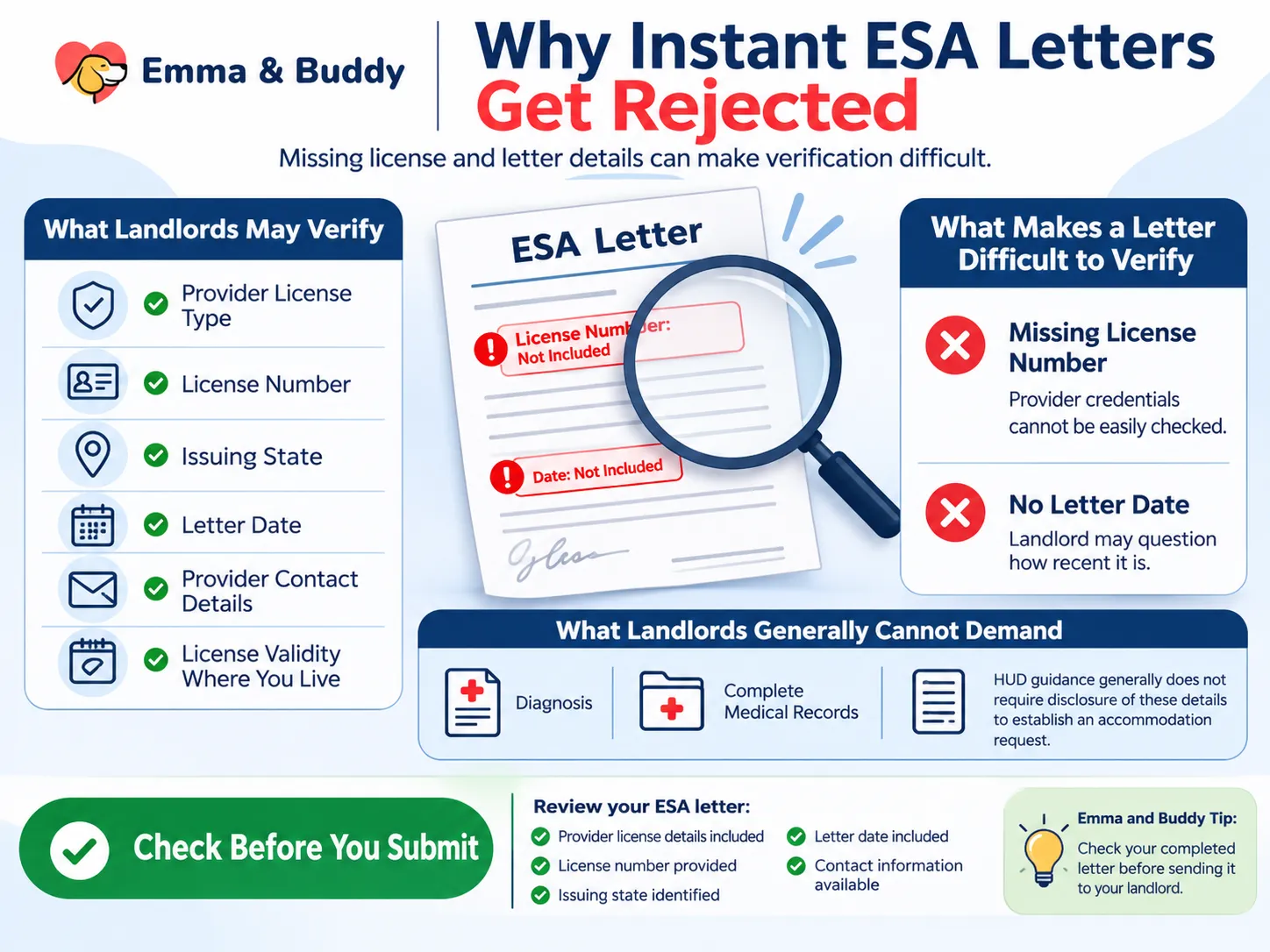
What landlords are allowed to question?
HUD’s 2020 guidance, FHEO-2020-01, says a landlord may ask for reliable documentation when your disability or need isn’t obvious. The documentation must reliably show both the disability and the disability-related need for the animal. A letter that can’t do that is easy to refuse, and that’s a big part of Why Instant ESA Letters Get Rejected.
Details a landlord checks on the page
According to ESA letter laws by state, A landlord may check the license type, license number, issuing state, letter date, and provider contact information. They may also confirm the provider is licensed where you live.
A landlord should not demand your diagnosis, medical records, or a specific form. If a request goes that far, you can decline.
HUD sets no expiration date, but many landlords want a letter from the past year. An old letter invites questions about whether your need still exists. Picture a renter whose letter has no date or license number. The landlord can’t verify it and may say no.
At Emma and Buddy, we suggest reading your finished letter for license details and a date before you send it. Missing details are often Why Instant ESA Letters Get Rejected.
Red Flags That Explain Why Instant ESA Letters Get Rejected
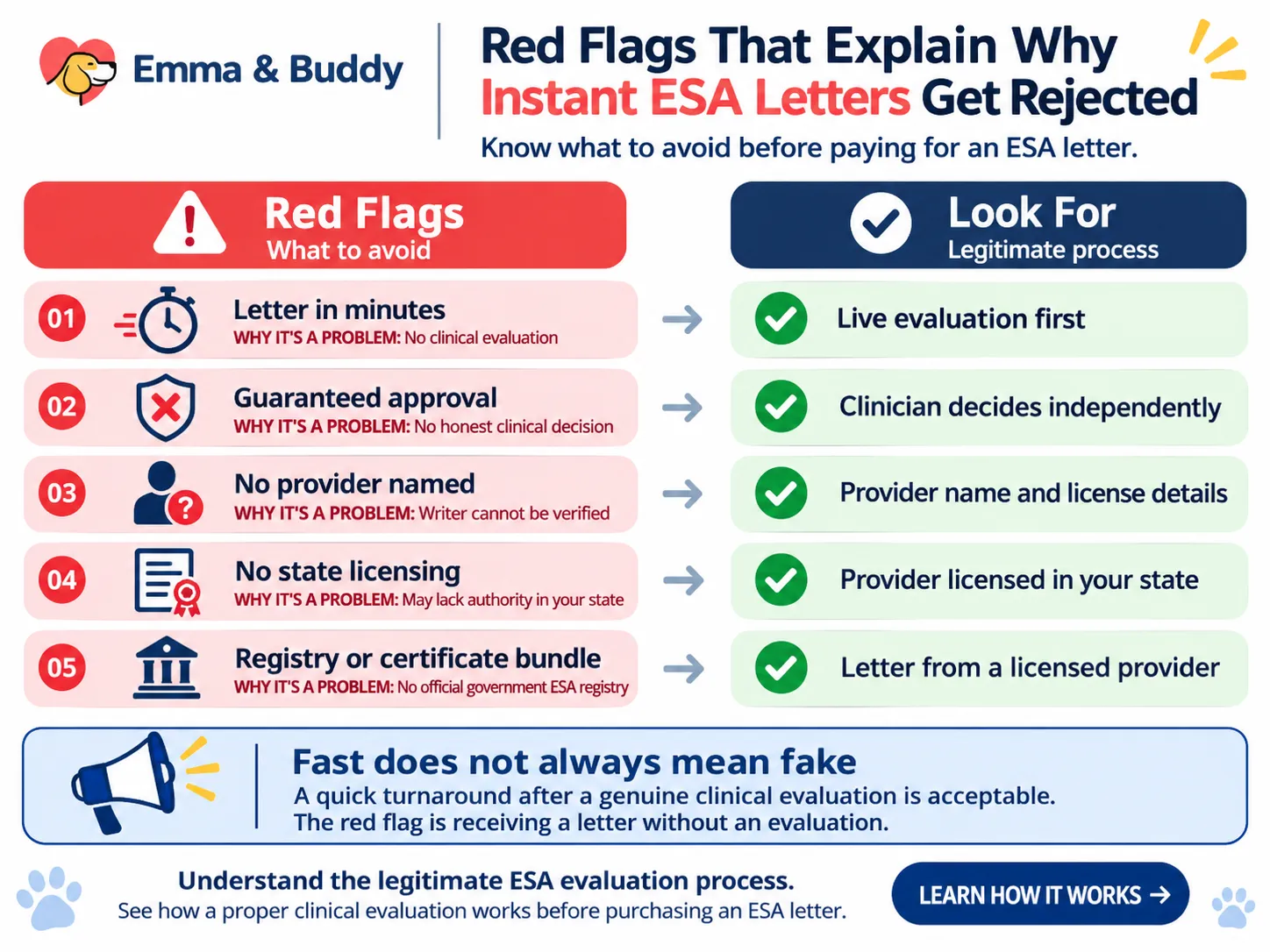
A rejected letter costs more than the fee. You may lose weeks while a move-in date or lease renewal passes. You might also pay pet fees or deposits, then pay again for a compliant evaluation.
Knowing why instant ESA letters get rejected saves money. Read refund policies first. Look for a clear refund if a landlord rejects the letter, and watch for vague wording.
Red flags to check before you pay
Scan these signs before you pay, since they show why instant ESA letters get rejected.
| Red flag | Why landlords reject it | What to look for instead |
|---|---|---|
| Instant approval or a letter in minutes | No sign a clinician evaluated you | A live evaluation first |
| Guaranteed approval | A real clinician may decline | An honest clinical decision |
| No licensed provider named | The landlord can’t verify the writer | Provider name, license type and number |
| No licensing in your state | The provider may lack authority where you live | A provider licensed where you live |
| Registry or certificate bundle | No government registry exists | A letter from a licensed provider |
A fast turnaround after a real evaluation is fine. The red flag is a letter with no evaluation behind it. Seeing how the evaluation works at a legitimate provider shows the difference.
How a Legitimate Evaluation Avoids the Reasons Why Instant ESA Letters Get Rejected
A real evaluation is a live conversation, usually by video, with a professional licensed in your state. The clinician asks about your condition, your daily life, and how the animal helps. Skipping this step is a main reason behind Why Instant ESA Letters Get Rejected.
The clinician decides whether you qualify, not a form. The letter is a clinical judgment, so it holds up better when a landlord questions it. It also carries a date and license details, and knowing how long an ESA letter lasts helps you renew it on time.
If your therapist won’t write an ESA letter
Therapists usually say no for one of four reasons. They may have no established treatment relationship, or a limit on their training or role. They may also worry about a dual relationship, or believe the criteria aren’t met. You can ask them to reconsider. Try this: “I’d like to talk about whether an ESA letter fits my treatment. What would you need to see from me to consider it?”
If the answer is still no, you have options. Ask what would change their mind, see another licensed provider, or book a telehealth evaluation with a provider licensed in your state. Understanding Why Instant ESA Letters Get Rejected helps you pick a provider who does a real evaluation first.
How to Start the Right Way and Avoid Why Instant ESA Letters Get Rejected
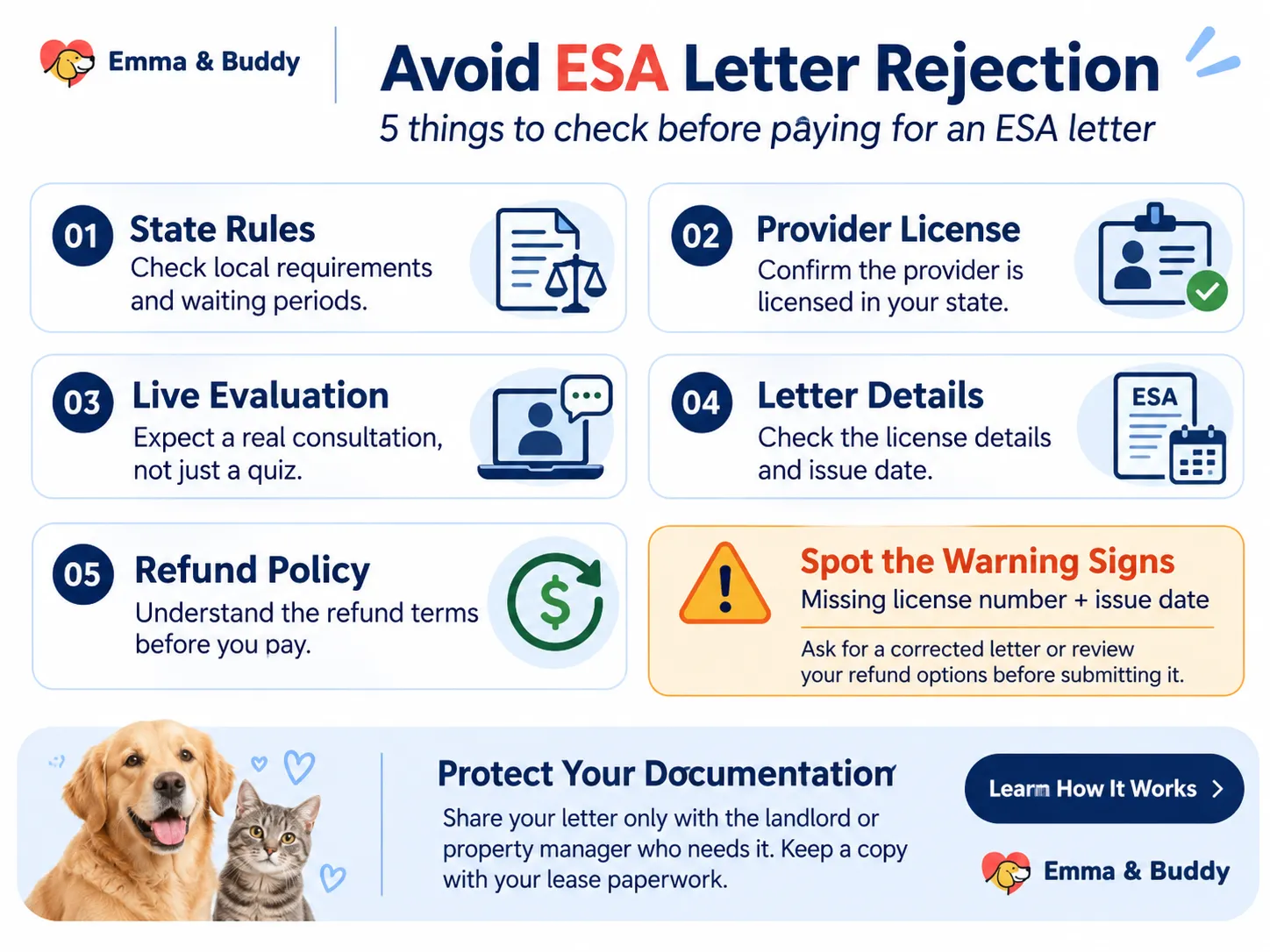
Learn Why Instant ESA Letters Get Rejected before you pay, then run through this list.
-
Check your state’s rules, including any waiting period.
-
Confirm the provider is licensed where you live.
-
Expect a live evaluation, not just a quiz.
-
Read the finished letter for license details and a date.
-
Check the refund policy first.
Here is a quick example. A renter reads a finished letter and finds no license number and no date. That renter can ask for a corrected letter or a refund before sending it to the landlord.
Once you have a letter, share it only with the landlord or property manager who needs it. Keep a copy with your lease paperwork for later.
Emma and Buddy follows a simple process. You complete an evaluation with a licensed provider, who then writes documentation for housing. This avoids the pattern behind Why Instant ESA Letters Get Rejected: no real conversation and no verifiable details. You can read each step on the Emma and Buddy how-it-works page, so you know what to expect before you pay.
Emma and Buddy also offers vet care and pet insurance, so your animal’s health is covered alongside the housing paperwork. That means one place for the letter and for ongoing care.
Conclusion
Why Instant ESA Letters Get Rejected comes down to one gap: speed replaced the evaluation. A letter holds up when a licensed professional in your state has assessed you and documented your disability-related need. A registry number, a certificate, or a same-day PDF can’t do that work, and landlords know it.
A rejected letter costs more than the fee. It can also eat weeks while a move-in date or lease renewal slips away. Before you pay, check these four things:
-
Your state’s rules for ESA documentation
-
The provider’s license and its status
-
The finished letter, which should show license details and a date
-
The refund policy, so a rejection doesn’t leave you paying twice
Fast service is fine when a real evaluation comes first. Ready to get it right the first time? Start with Emma and Buddy’s ESA letter process and work with a licensed provider who evaluates you before writing anything. You can also ask us about vet care and pet insurance, so your animal’s health is covered too.





 Ask ChatGPT
 Ask Claude
 Ask Perplexity