
ESA Letter vs ESA Registration
The ESA Letter vs ESA Registration question has a short answer. Only a letter from a licensed professional carries weight with landlords. No official federal registry exists for emotional support animals. A registration, certificate, ID card or vest has no legal standing under the Fair Housing Act.
Many sellers blur the two terms on purpose. Owners pay for documents that look official, then get turned away at the leasing office. This guide explains what each document is and how they differ. You’ll learn what a valid letter must include and how a real evaluation works. You’ll also see why instant letters and registry IDs get rejected. Then you’ll know how to start with a licensed therapist and what it costs. It’s written for beginners and based on US federal rules as of 2027.
ESA Letter vs ESA Registration: What an ESA Letter Actually Is

In the ESA Letter vs ESA Registration question, the short answer is simple. No federal law requires you to register an emotional support animal. A letter from a licensed mental health professional is the only document that carries weight with a landlord.
An ESA letter is a signed statement from a licensed professional. It says you have a mental health condition and that your animal helps with it.
Registration is different. It’s a database entry sold by private companies. No official national ESA registry exists, and no government body maintains these listings. That means they have no legal standing.
The myth persists because of how sellers package their products. Some bundle a paid listing with a letter. Others sell the listing alone. Buyers see the word “registered” and assume the listing is the legal requirement. Many ESA registration scams rely on this confusion.
What to Weigh Before You Buy
Picture a renter who pays for an online listing and a printed card, then hands both to a landlord. The landlord can still ask for reliable documentation from a licensed professional. The card and the listing don’t answer that request, so the purchase can cost you time during a move.
If housing is your goal, start with how an ESA housing letter works with landlords. Do that before you spend money on anything else. The next section sets up the ESA Letter vs ESA Registration comparison side by side. You can see what each item does and what it doesn’t.
ESA Letter vs ESA Registration: Main Differences Side by Side
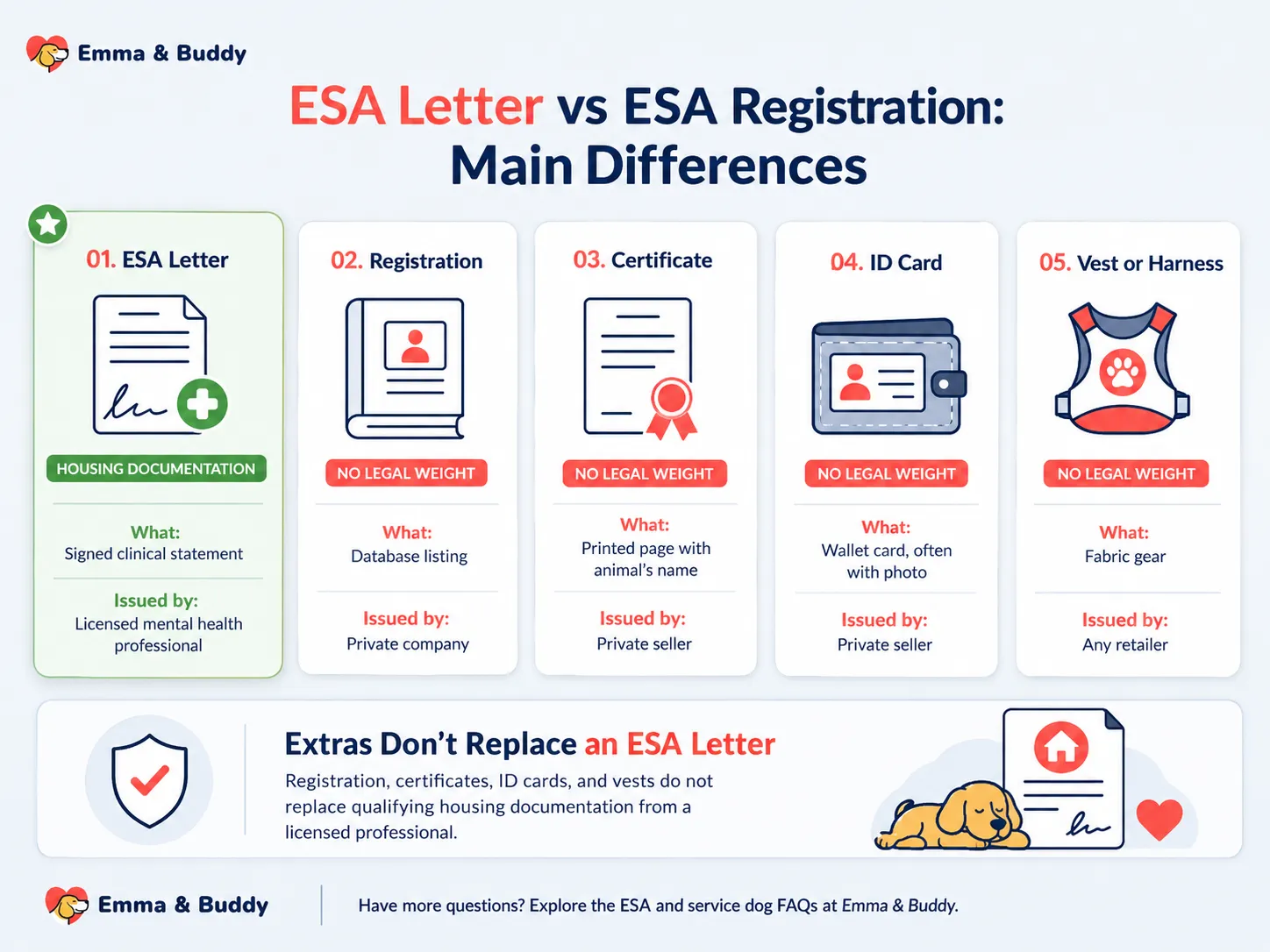
Sellers often bundle several items together, so it helps to compare each one with the letter. The table shows what each item is, who issues it, and whether it carries legal weight.
ESA Letter, Registration, Certificate, ID Card and Vest Compared
| Item | What it is | Who issues it | Legal weight? |
|---|---|---|---|
| ESA letter | Signed statement that you have a mental health condition and the animal helps | Licensed mental health professional | Yes, for housing |
| Registration | Database listing | Private company | No |
| Certificate | Printed page with your animal’s name | Private seller | No |
| ID card | Wallet card, often with a photo | Private seller | No |
| Vest or harness | Fabric gear | Any retailer | No |
Takeaway: paying for extras never replaces the letter. The ESA and service dog FAQs answer common follow-up questions.
Each extra buys something small. A registration buys a database listing. A certificate or ID card buys paper or plastic. A vest buys fabric. None of them replaces a clinician’s signed letter, which is the core of ESA Letter vs ESA Registration.
How Sellers Word Registrations to Sound Official
Sellers borrow legal-sounding words to make a paid listing look required. Here is what the common terms mean in practice:
-
Official usually means the seller named its own product. No agency is involved.
-
Certified means the seller approved itself, not a licensing board.
-
Nationally recognized means many people visit the site. No government body recognizes it.
Picture a renter who sees “official ESA registration” at checkout and assumes the law requires it. The landlord still asks for reliable documentation from a licensed professional, and a card or listing isn’t that. Emma and Buddy connects owners with licensed providers, so the letter comes from a clinician. When you weigh ESA Letter vs ESA Registration offers, ask who signs the document.
ESA Letter vs ESA Registration: Requirements and How the Evaluation Works
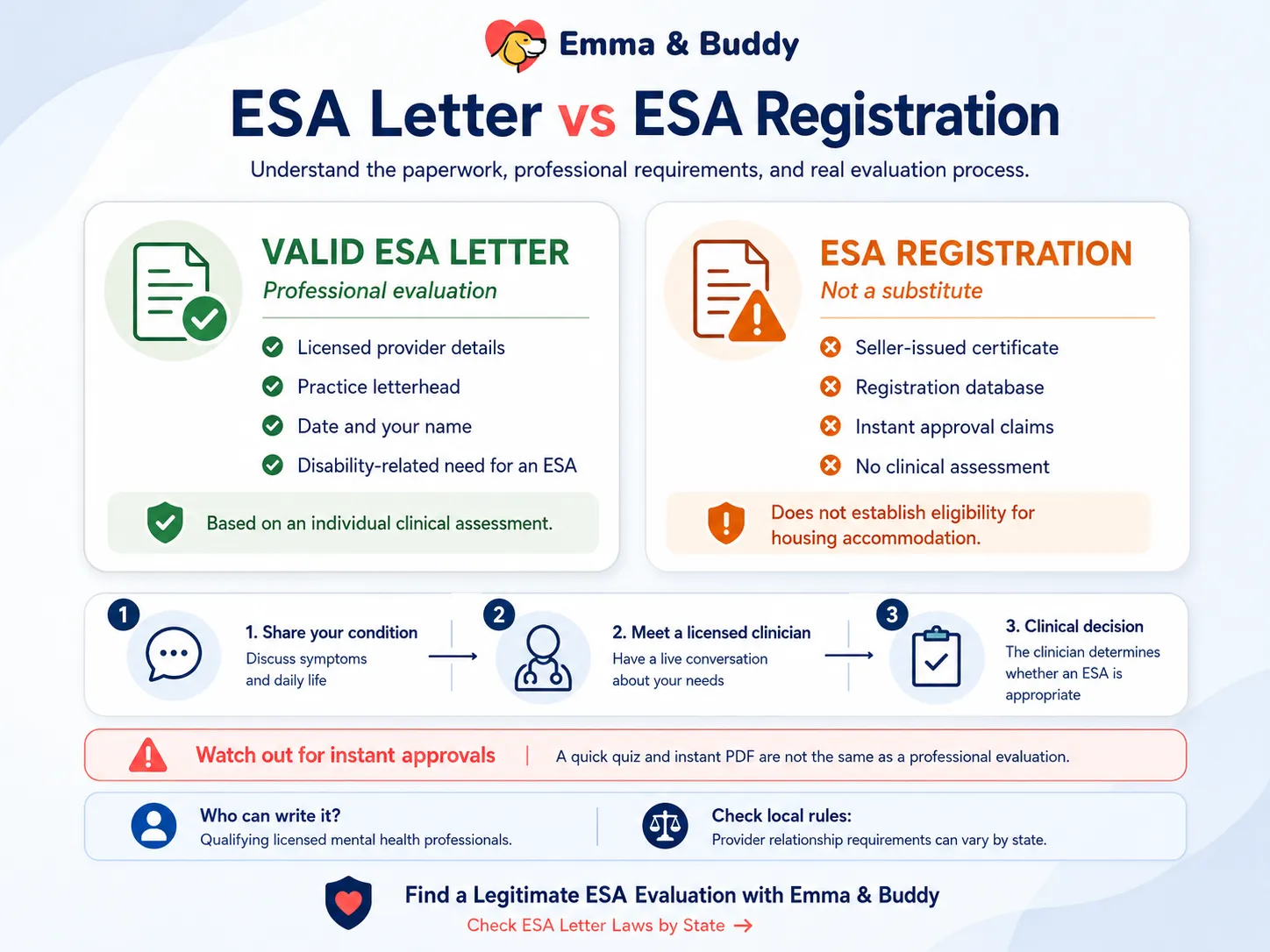
What a Valid ESA Letter Must Include
The ESA Letter vs ESA Registration question comes down to which paperwork a landlord can trust. A valid letter includes these parts:
-
The professional’s license type, license number and state
-
Letterhead from the clinician or practice
-
The date
-
Your name
The letter states that you have a condition recognized as a mental health disability and that the animal helps with it. It does not need to name your diagnosis. Some landlords ask for a recent date, so keep your letter current.
An ESA may support conditions such as anxiety, depression or PTSD. Only a licensed professional can decide whether you qualify. You can also see which animals qualify before you start.
A licensed therapist, counselor, psychologist, psychiatrist or other qualifying clinician can write the letter. A seller’s own “certification” does not count, since the seller isn’t treating you.
What a Real ESA Evaluation Looks Like
A proper assessment starts with questions about your condition and daily life. You then talk live with the clinician, who decides whether an ESA fits your needs. An instant approval form skips all of this.
Picture a renter who pays, clicks through a quiz and gets a PDF in minutes. That renter bought a product, not an evaluation, and a landlord may reject it. This gap is why the ESA Letter vs ESA Registration difference matters.
Rules also vary by location, including state laws and provider-relationship requirements. Check the ESA letter laws by state before you pick a clinician. Emma and Buddy offers a digital process that connects owners with licensed providers. Knowing how ESA Letter vs ESA Registration rules play out where you live helps you spot a weak offer early.
ESA Letter vs ESA Registration: Why Instant Letters and Registry IDs Get Rejected

Landlords reject paperwork that doesn’t prove a licensed professional reviewed your case. A registry ID shows only that you paid a website. In the ESA Letter vs ESA Registration debate, that gap explains most rejections.
Where an ESA Letter Applies: Housing, Air Travel and Public Spaces
Housing is where a letter matters most. The Fair Housing Act lets a tenant with a disability request a reasonable accommodation for an ESA, even in some no-pet housing. Landlords may ask for reliable documentation from a licensed professional. They may not demand a registry ID or your diagnosis. They can deny a request if the animal poses a direct threat. HUD guidance explains these rules.
Travel and public spaces work differently. The Department of Transportation revised its rules in 2027, so airlines no longer have to treat ESAs as service animals. Check your airline’s current pet policy and fees before you book. The ADA covers trained service animals, not ESAs, so stores and restaurants can refuse an ESA.
| Setting | Status |
|---|---|
| Housing | Protected |
| Air travel | Not required |
| Public places | Not covered |
ESA Registration Scams and Red Flags to Avoid
Sellers profit from the ESA Letter vs ESA Registration confusion. Watch for these warning signs:
-
Instant approval with no evaluation
-
No named licensed clinician
-
“Official registration” for sale
-
Claims like “accepted everywhere”
-
Pressure tactics, such as countdown timers
-
Hidden renewals
-
“Lowest price guaranteed” with no proof
A quick check protects your money. Follow these steps before you pay:
-
Ask for the clinician’s name and license number.
-
Confirm the license with the state board.
-
Read the refund and landlord-rejection terms.
A trustworthy provider will gladly explain how the licensed provider process works before you pay. If a site dodges that question, walk away.
Maybe you already bought a registration or certificate. It’s harmless but useless, because no landlord needs it. Get a proper letter from a licensed clinician instead. If the seller promised legal status, ask for a refund. Once you understand the ESA Letter vs ESA Registration difference, you can spend only on what a landlord will accept.
ESA Letter vs ESA Registration: How to Start With a Licensed Therapist
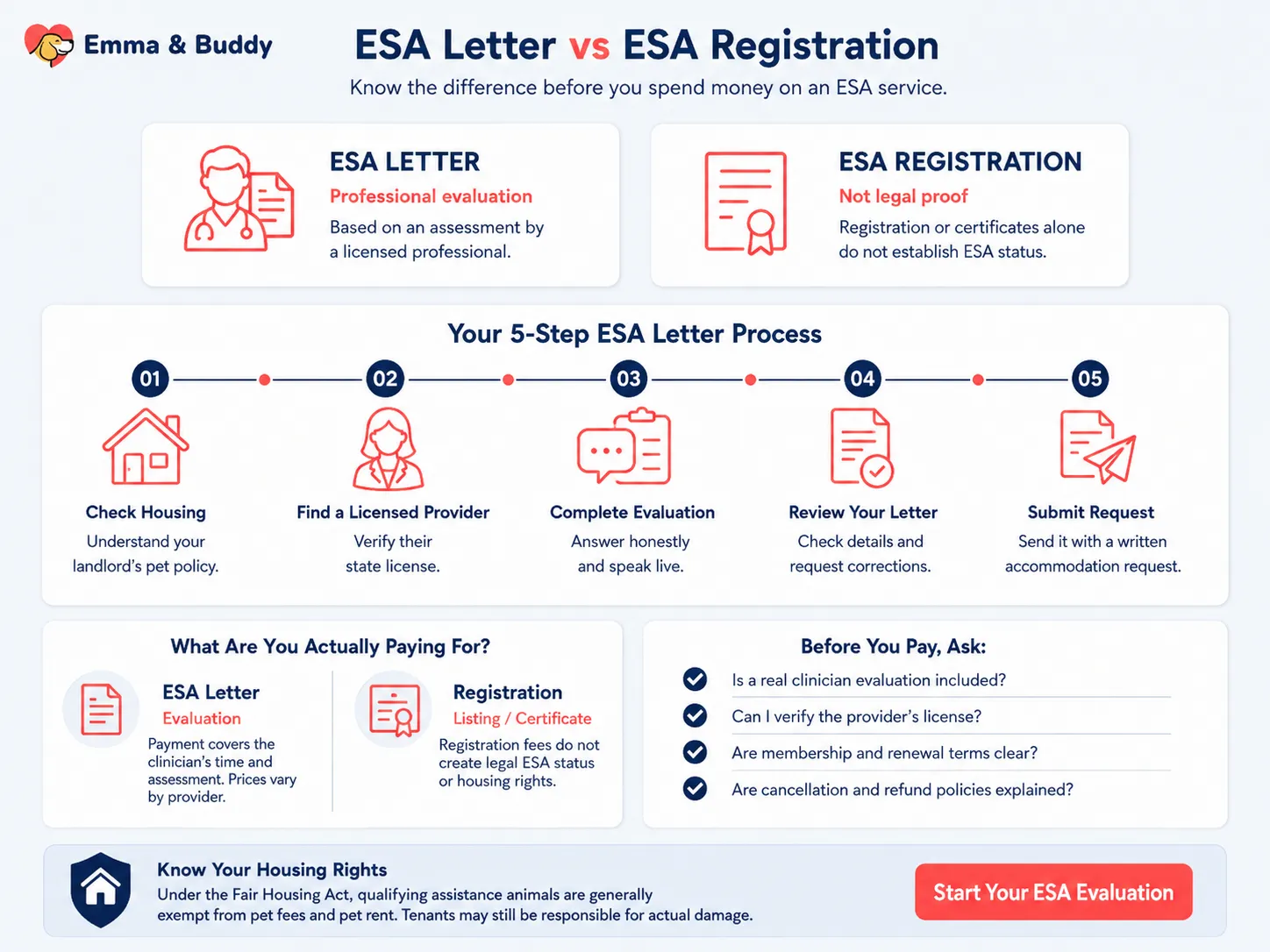
The ESA Letter vs ESA Registration choice gets easy when you follow five steps.
-
Decide if you need a letter. Look at your housing. If your landlord has a no-pet rule, a letter may help.
-
Choose a licensed professional. Use your current provider or a telehealth provider licensed in your state. Verify the license number with the state board.
-
Complete the evaluation. Answer questions honestly and talk with the clinician live.
-
Review the letter. Compare it with the checklist from the requirements section and ask the clinician to fix any missing details.
-
Give it to your landlord. Attach a written accommodation request, keep copies, and follow up.
Emma and Buddy offers a digital process that connects owners with licensed providers, which is one example of the telehealth route. Before you pay anyone, get information about the animals that qualify for ESA letters, because the clinician decides whether your pet fits.
What an ESA Letter Costs and What to Ask Before You Pay
A letter pays for a clinician’s time and evaluation. Prices vary by provider, so compare a few instead of trusting one number. In the ESA Letter vs ESA Registration comparison, registration and certificate fees buy a listing or a printed item with no legal value.
Ask about membership terms, annual renewals, cancellation and refunds. Under the Fair Housing Act, landlords may not charge pet fees or pet rent for an ESA. They can charge for actual damage.
Use this ESA Letter vs ESA Registration budget checklist before you buy:
-
Is the price for a real clinician evaluation?
-
Can I verify the license number?
-
What are the membership and renewal terms?
-
Can I cancel and get a refund?
Conclusion
The ESA Letter vs ESA Registration question comes down to one line: a letter protects you, and a registration is just a purchase. No law requires you to register an emotional support animal, and no official federal registry exists. Certificates, ID cards and vests carry no legal weight. Airlines no longer have to accept ESAs, and stores and restaurants can turn them away. Housing is where your ESA keeps its protection under the Fair Housing Act, and landlords look for one thing there: a letter from a licensed mental health professional.
Before you spend a dollar, take three steps. First, verify the clinician’s license with your state board. Second, skip paid registries, since they sell a listing and nothing more. Third, when your letter arrives, send it to your landlord with a written accommodation request.
Your animal already supports you. Give that bond the paperwork landlords actually respect. Start your licensed evaluation with Emma and Buddy’s digital ESA letter process today. Once your housing is secure, you can also explore their pet insurance and 24/7 vet services to keep your companion healthy and by your side.





 Ask ChatGPT
 Ask Claude
 Ask Perplexity